Birthday of Yeshua Messiah
On December 25, Christians around the world gather to celebrate Yeshua's birthday. Was Yeshua Messiah really born on December 25? If not, when was the exact date of his birth? Although the Scriptures do not directly tell us the exact birthday of Yeshua, can we identify it? Great efforts have been made to obtain the exact birthday of Yeshua for about 2,000 years, no consensus has been reached so far. Here, we attempt to determine the true birthday (9 March 5 BC) of Yeshua from Biblical, astronomical, and historical records.
Yeshua's birth on Nisan 1
In order to identify the true birthday of Yeshua, we need to find hints from the Scriptures. In the previous chapters, we have proved that Yeshua is the Messiah, the Son of God, the Son of Man, the Word of God, the Passover Lamb of God, the Messenger of Yehowah God who bears the Name of Yehowah. He is the regent of Yehowah God, speaking and acting on behalf of Yehowah.
Matthew cited the Hebrew Bible, saying, "Behold, a virgin (young woman) shall be with child, and shall bring forth a son, and they shall call his name Emmanuel, which being interpreted is, God with us." (Matthew 1:23). Matthew tells us that the birth of Yeshua signifies "God is with us" or "God dwells among us."
Apostle John stated (John 1:14): "And the Word became flesh and dwelt among us, and we beheld his glory, the glory as of the only begotten of the Father, full of grace and truth." John also declared that the Word was with God from the beginning (John 1:1). He speaks and acts exactly according to what his Father tells him. "No one has seen God at any time. Only the begotten Son, who is in the bosom of the Father, has declared Him." (John 1:18). The Son of God appeared to Moses as the Messenger of God, who bears the Name of Yehowah (Exodus 23:20-23). The Messenger of God is the same as the Word of God because he speaks the Word of God on God's behalf and with the same authority of God. The Son of God became flesh and directly appeared to the Israelites on behalf of his Father. This is the most direct signature of "God's dwelling among us."
Moses also told us that the tabernacle (the simple tent-sanctuary) was the portable earthly meeting place of God with the children of Israel from the time of the exodus of Egypt. The tabernacle is the symbol of "God dwelling among us" in the time of Moses (Exodus 25:8) and in the eternal Kingdom of God (Revelation 21:3).
Since both the tabernacle and the incarnated Son of God (the Messiah) symbolize the dwelling of God among us, setting up God's tabernacle in the time of Moses should have been a foreshadow of the Messiah's birth. God instructed Moses, "On the first day of the first month (Nisan 1) shall you set up the tabernacle of the tent of the congregation. And you shall put in it the ark of the testimony, and cover the ark with the veil." (Exodus 40: 2-3). "And it came to pass in the first month in the second year, on the first day of the month, that the tabernacle was raised up." (Exodus 40:17). Moses indeed set up the tabernacle on Nisan 1. This provides a strong hint that Yeshua should have been born on Nisan 1 if he is the true Messiah and his name is called Emmanuel.
When should Yeshua have been conceived if he was born on Nisan 1? We can find a hint from the starting time of building the tabernacle. In the third month—according to Jewish sage, the first day of that month (Exodus 19:1, NIV) marks the time more explicitly, that is, 45 days after the exodus from Egypt on the first Passover (Nisan 15). Moses spent one day on the mountain (Exodus 19:3), one day returning the people's answer (Exodus 19:7-8), three days of preparation, making the whole time 50 days from the first Passover to the promulgation of the Law (Ten Commandments) and the establishment of God's covenant with the Israelites. Hence on the Feast of Pentecost, that is, in the sixth day of the third Hebrew lunar month (Sivan 6), the covenant of God with the Israelites was established. After God made the covenant, He called Moses out of the midst of a cloud and Moses went up into the mountain in the seventh day of the third lunar month (Exodus 24:16-18). It was on the 7th day of the third month, Moses went up into the mountain and was instructed by God to build the tabernacle.
From the promulgation of the Law on the day of Pentecost (14 June 1457 BC) to setting up the tabernacle on the next Nisan 1 (31 March 1456 BC), there were 290 days, which is close to the duration of a woman's pregnancy in the ancient time (in ancient China, the normal pregnancy lasted about 10 lunar months from the time of conception, that is, about 295 days). Since the power of the Spirit of God made Virgin Mary conceive Yeshua, the conception should have also taken place on Pentecost, the very day the almighty God selected for the promulgation of His law.
Yeshua is not only the Messiah but also the Passover Lamb of God. According to the Hebrew Bible, the Passover lamb must be one year old, implying that the Passover lamb must be born in the month of Nisan. Therefore, Yeshua must have been born on Nisan 1 in order for him to be both the Messiah and the Passover Lamb of God.
Messiah's birth on Nisan 1 (March 9) of 5 BC
Matthew's account of Yeshua's nativity gives us a hint that he must have been born before Herod died, "Now when Yeshua was born in Bethlehem of Judea in the days of Herod the king, behold, there came wise men from the east to Jerusalem." (Matthew 2:1). It has been generally accepted that Herod died in the spring of 4 BC. In Chapter 13, we have unambiguously proved that Herod indeed died near the end of March of 4 BC.
According to the Law, a prophet must be at least 30 years old. Ezekiel was called to be the prophet of God in the 30th year of his life (Ezekiel 1:1). Since Yeshua was also the prophet Moses foretold (Deuteronomy 18:18), he must have been at least 30 years old when he began to minister and speak the words of God. In Chapter 12, we have shown that Yeshua was declared to be the Lamb of God by John the Baptist on Nisan 10 of 27 AD and called his disciples on Nisan 11 of 27 AD (April 6). If he was born on 1 Nisan 5 BC, he was 31 years old when he started to minister on Nisan 11 of 27 AD.
Nisan 1 of 5 BC was on March 9 according to the astronomical new moon data and the rules for the Hebrew lunisolar calendar (see Appendix D). If Yeshua was indeed born on 9 March 5 BC, his birthday should be consistent with the star of Bethlehem recorded by Matthew (2:1-12). If Yeshua was born on 9 March 5 BC, Yeshua should have been conceived on the Feast of Pentecost of 6 BC, which was on May 24. From 24 May 6 BC to 9 March 5 BC, there were 290 days.
The star of Bethlehem
The star of Bethlehem was recorded in Matthew 2:1-12:
The account in the Gospel of Matthew describes how the Magi saw a star which they believed to herald the birth of the Messiah-King of Jews and how they followed the star to find the child and presented their gifts to him.
The star of Bethlehem has been considered to be mythical and unrelated to a real astronomical phenomenon. Here, we show that the star of Bethlehem was a new sword-like star near α-Altair, which was observed by the Chinese astronomers in the second Chinese lunar month of 5 BC, which was between March 9 and April 7.
There are several characteristics of the star of Bethlehem recorded in Matthew's Gospel. The characteristics are as follows:
1. It should be a star which had newly appeared. The best candidate should be a bright nova or supernova.
2. The star was seen in the east by the Magi in the time of the Messiah's birth (Matthew 2:2). When they came to Jerusalem and were sent to Bethlehem by Herod, the star in the east went ahead of them during their journey to Bethlehem, which is due south of Jerusalem. This implies that the star slowly moved through the sky from the east to the south during traveling of the Magi from their country to Jerusalem.
3. The star "stood over" Bethlehem. Matthew 2:9 records that the star "went ahead of them and "stood over" the place where the child was." According to Matthew, the star, as viewed from Jerusalem, "stood over" Bethlehem.
4. The Magi should have arrived in Bethlehem after Mary the mother of Yeshua was ceremonially clean. This should have been at least 40 days after she gave birth to the male child (Yeshua) according to Leviticus 12:1-4: "If a woman has conceived, and borne a male child: then she shall be unclean seven days; as in the days of her customary impurity shall she be unclean. And in the eighth day the flesh of his foreskin shall be circumcised. And she shall then continue in the blood of her purification three and thirty days; she shall touch no hallowed thing, nor come into the sanctuary, until the days of her purification be fulfilled."
A "comet"-like star observed by the Chinese astronomers meets the above characteristics. It was newly formed and "stood over" in the sky. The phrase "stood over" or "hung over" was uniquely applied to describe a comet in ancient literature. For example, Josephus stated: "a star, resembling a sword, stood over the city" (Wars, bk. 6, ch. 5, sect. 3). We have shown that he refers to a long star (extending 37 degrees) observed also by the Chinese astronomers on 29 July 65 AD. This star appeared for 56 days according to the Chinese record. Unlike a Halley comet that travels in the sky about 2-5 degrees per day, the long star does not change its position in the sky. Although the ancient Chinese astronomers did not clearly distinguish between a long star (possibly bright nova or supernova) and a comet, the detailed descriptions of their sky behaviors (e.g., position and brightness) were different. Josephus also made the distinction between a sword-like star and a comet, both of which were observed before the Jewish war that started in April of 67 AD (Wars, bk. 6, ch. 5, sect. 3).
A sword-like star for the Messiah appears to be foretold in the Hebrew Bible in Numbers 24:15-19 (Balaam fourth Oracle): "And he took up his oracle, and said, Balaam the son of Beor has said, and the man whose eyes are open has said: He has said, who heard the words of God, and knew the knowledge of the Most High, who saw the vision of the Almighty, falling into a trance, but having his eyes open: I shall see him, but not now: I shall behold him, but not near: there shall come a star out of Jacob, and a scepter shall rise out of Israel, and shall crush the forehead of Moab, and destroy all the children of Sheth. And Edom shall be a possession, Seir also shall be a possession for his enemies; and Israel shall do valiantly. Out of Jacob shall come he that shall have dominion, and shall destroy him that remains of the city."
The Oracle foretold that a star would come out of Jacob and a scepter would rise out of Israel in far future to have dominion over the nations. Here, the second sentence essentially repeats the first sentence to imply that a new star resembling a scepter will come out of Israel. The new star resembling a scepter (sword) is the star of the Messiah who will rule the nations with a rod of iron and with a sharp sword in his mouth. Therefore, a long star resembling a sword should be the best candidate for the star of Bethlehem.
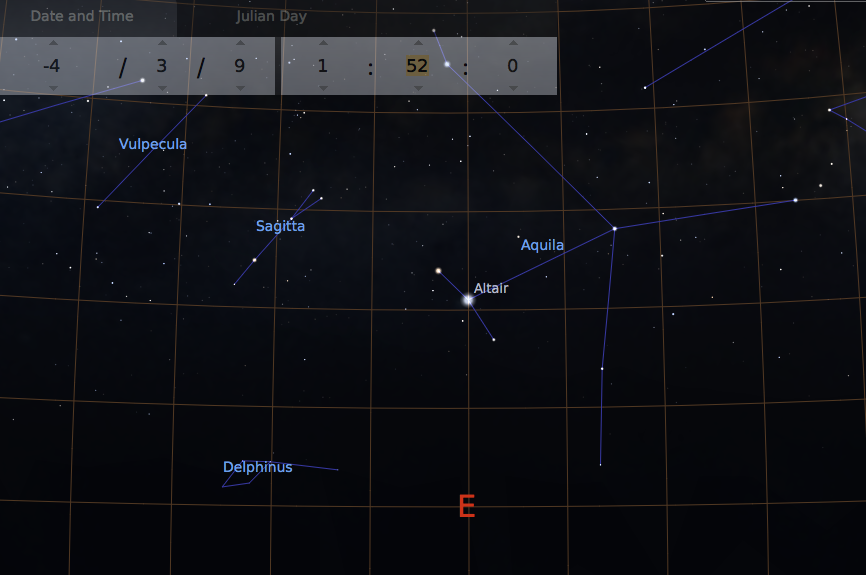
Figure 13: Sky view from Baghdad on 9 March 5 BC, as predicted from the Stellarium Program. The position of α-Altair at 1:52 was at 90 degrees, due east of Baghdad.
The Chinese chronicle (in Qian Han Shu) recorded: "In the second year of the reign period of Jian-Ping, second month, a hui-xing (comet) appeared in qian-niu for more than 70 days."
This record tells us that during the interval between March 9 and April 7 of 5 BC (the second Chinese month), a comet was visible for more than 70 days near α-Altair. Although hui-xing refers to a comet, it could also refer to a bright nova. For example, both the Chinese and European astronomers used the word "comet" to describe the supernova of 1572 AD. Since the "comet" did not move in the sky, it must be a long star resembling a sword.
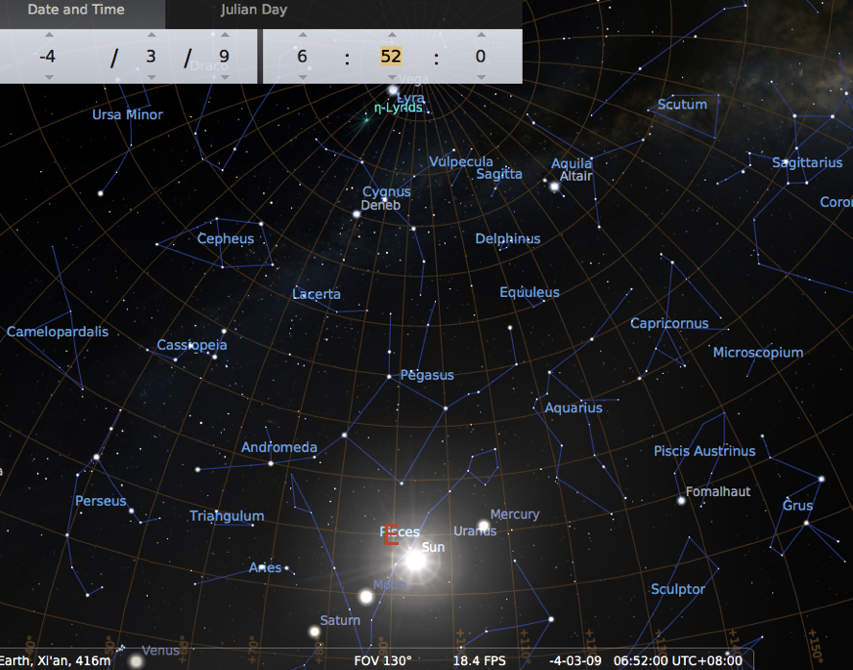
Figure 14: Predicted sky view from Xi-An, China on 9 March 5 BC. The position of α-Altair at 6:52 was at about 150 degrees, south-east of Xi-An.
In Figures 13 and 14, we show the predicted sky views on 9 March 5 BC, which were observed from Baghdad (close to Babylon) of Iraq and from Xi-An (the capital city of Eastern Han Dynasty) of China, respectively. The sky views are predicted from the Stellarium Program. The position of α-Altair at 1:52 on March 9 of 5 BC was due east of Babylon (see Figure 13). If the comet-like star appeared near α-Altair at 1:52 Babylon time, it was seen in the direction of due east (the cardinal compass point is at 90 degrees), in agreement with Matthew 2:2. The Jerusalem time was at 0:52 on 9 March 5 BC, which was on Nisan 1. The Xi-An time was at 6:52 on 9 March 5 BC, which was the first day of the second Chinese month. The position of α-Altair seen from Xi-An was at about 150 degrees, south-east of Xi-An (see Figure 14). The comet-like star near α-Altair should have been visible in China at this time because it was about 20 minutes before sunrise. The comet-like star could have been seen in China on any clear day of the second Chinese month if the new star appeared for 70 days and was first seen at 0:52 Jerusalem time on 9 March 5 BC, the time when Yeshua was born.
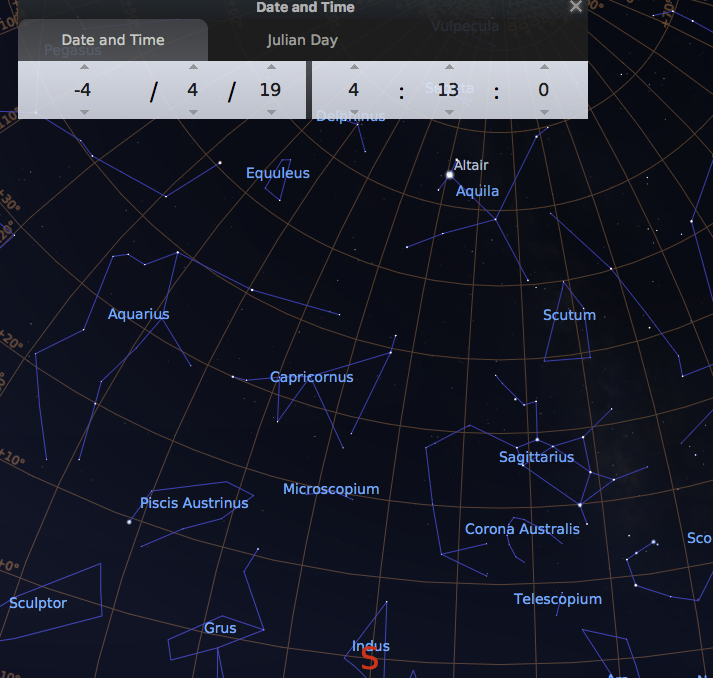
Figure 15: Predicted sky view from Jerusalem on April 19 of 5 BC. The position of α-Altair at 4:13 was at 180 degrees, due south of Jerusalem.
After the Magi saw the star in the east on March 9, they may have immediately left Babylon for Jerusalem. How long did they take to travel from Babylon to Jerusalem? The distance is about 900 miles if they traveled through the Fertile Crescent. If they rode on their donkeys, they should have been able to travel 25 miles per day comfortably. So it is reasonable that the Magi took about 6 weeks from first sighting the star until their arrival in Jerusalem.
On 19 April of 5 BC, six weeks after Yeshua was born, the position of α-Altair at 4:13 was at 180 degrees, due south of Jerusalem (see Figure 15). This is consistent with Matthew's account (Matthew 2:9). The six weeks were still well within the period (10 weeks) of visibility of the Chinese comet-like star. The Magi should have been able to see the star in the early morning when the sky was clear. If they rode on their donkeys and traveled to the west, they should not have been able to see the star even if the sky was clear in the morning. If the Magi arrived in Jerusalem on 18 April 5 BC and the sky was not clear, they could not have seen the comet-like star when they left Jerusalem for Bethlehem in the early morning of April 19. Due to a possible divine interference, the sky may have suddenly become clear around 4:00 am to allow the Magi to see the star in the due south of Jerusalem. Since both Bethlehem and the star were due south of Jerusalem, the comet-like star appeared to "hang over" Bethlehem to the eyes of the Magi.
This new comet-like star is indeed the best candidate for the star of Bethlehem described in the Gospel of Matthew. Is it significant that the star was born near α-Altair. We know that α-Altair is the brightest star in the constellation of Aquila and the 12th brightest star in the night sky. The ancient Babylonians called α-Altair the eagle star. The ancient Chinese called it Niu Lang Xing (the oxherd star). In the vision of Ezekiel, he saw the appearance of the glory of Yehowah God. Within it there came the likeness of four living creatures (Ezekiel 1:5) and each one had four faces, one like the face of a man, one like the face of a lion, one like the face of an ox, and one like the face of an eagle (Ezekiel 1:10). His vision tells us that eagle is one of the four perspectives of the likeness of the glory of Yehowah God. This is also consistent with Exodus 19:4, "You have seen what I did unto the Egyptians, and how I bore you on eagles' wings, and brought you unto myself." Since there were four eagle faces in the vision of Ezekiel, Yehowah God carried the Israelites on the wings of eagles (plural form) and brought them into Himself. Therefore, we may assign α-Altair into the Star of the Father and the new sword-like star into the star of the Messiah.