APPENDIX B Paper on the Nonconstancy of the Speed of Light
Are atomic clocks and the speed of light slowing down?
Peter Zhao
Taizhou Research Institute, Zhejiang University, China
Abstract
We report our time-keeping results for four extremely precise quartz watches of different ages against the world atomic clock that keeps the Coordinated Universal Time. Compared with the quartz clocks, the atomic clock has been slowing down with a rate of 84.3±2.5 ppb per year for the last 40 years. Because quantum theory predicts that the frequency or the tick rate of the atomic clock is linearly proportional to the speed of light in vacuum and because the frequency of the quartz vibration should not increase with time, our data suggest that both the atomic clock and the speed of light should slow down over time. The present result agrees with other independent experiments on as-maintained electrical units in the 1960's and with the theoretical prediction of both the general theory of relativity and Maxwell's equations.
Introduction
When the cesium-based atomic clock was used to measure the time or frequency f, the speed of light in vacuum c was found to be time-independent between 1972 and 1983 (variation is less than 0.4 ppb per year). The c value was determined according to the formula: c = λf, where λ is the wavelength of the emitted light of an atom. Because the Rydberg constant $R_{\infty}$ is found to be time-independent within the experimental uncertainties of less than 1 ppb per year [1-4] and because $1/\lambda$ $\propto R_{\infty}$ (see the Bohr model of hydrogen spectra for example), λ is also expected to be time independent. Since the tick rate of a cesium-based atomic clock is linearly proportional to c (see our theoretical proof below), the c value "measured" from such emissive experiments will always be a constant independent of whether c is intrinsically time-dependent or not. Therefore, the constancy of the speed of light cannot be tested by cesium atomic clocks.
The general theory of relativity appears to predict that the vacuum permittivity $\epsilon_{0}$ should be time-dependent [5-7]. In generalizing Maxwell's equations to the coordinates of general relativity, Møller [5] showed that $\epsilon_{0}$ is a function of the Friedmann radius a(t), which is time dependent. The same conclusion was also reached by Landau and Lifshitz [6]. In the 1990's, Sumner re-considered the equations of Einstein and Maxwell together [7] and also showed that the energy of the electrical field is proportional to 1/a(t) and $\epsilon_{0} \propto a(t)$. As seen below, the vacuum permeability μ~0~ should be a true constant, the relationship $c = 1/\sqrt{\varepsilon_{0}\mu_{0}}$ leads to $c \propto 1/\sqrt{\varepsilon_{0}}$, which is time dependent.
The fine-structure constant α and the Rydberg constant $R_{\infty}$ are time-independent within the experimental uncertainties of less than 1 ppb per year [1-4]. According to the general theory of relativity and the Maxwell's equations, the mass and charge of a point particle also remain constant as spacetime geometry changes [7]. The simple relationship [8]:$ m_{e} = \frac{2R_{\infty}h}{c\alpha{2}}$ and time independency of the electron mass *m*~e~ lead to the time-dependent Planck "constant" *h* $\propto$ *c* while the relationship [8]: $\alpha = \frac{e{2}c\mu_{0}}{2h}$ and time independency of the electron charge e imply that $\mu_{0}$ is a true constant independent of whether c changes over time or not.
Here, we report our time-keeping results for four extremely precise quartz watches of different ages against the world atomic clock that is used to keep the Coordinated Universal Time (UTC). These watches were made in 1980, 1991, 2007, and 2013, and have accuracies rated as ±5, ±10, ±10, and ±5 seconds per year, respectively. By carefully comparing the tick rate of the world atomic clock with those of the quartz watches, we find that the world atomic clock is slowing down by 2.66±0.08 seconds every year or by 84.3±2.5 ppb every year. Because the frequency of the atomic clock is linearly proportional to the light speed c, our data suggest that both the atomic clock and the speed of light slow down over time.
Theory
In atomic physics, hyperfine structure in an atom arises from interaction between the nucleus and outer electrons. This interaction leads to small shifts or splits in the energy levels. For a nuclear magnetic dipole moment placed in the magnetic field of an electron cloud, the relevant term in the Hamiltonian is given by [9]:
where $g_{I}$gI is the nuclear g-factor, $\mu_{N}$μN is the nuclear magneton, $\mathbf{I}$ is the nuclear spinI, $\mu_{B}$ is Bohr magneton, and
$\mathbf{ N = I -}\left( \frac{g_{s}}{2} \right)\left\lbrack \mathbf{s} - 3\left( \mathbf{s} \bullet \widehat{\mathbf{r}} \right)\widehat{\mathbf{r}} \right\rbrack,$
where$ g_{s}$gI is the free electron g-factor and s is the spin of an electron. Using the relationship [8]:
where $A_{r}(e)$ and $A_{r}(p)$ are the masses of one mole of electrons and protons, respectively, and [8]
We obtain
The frequency f of the electromagnetic radiation used for the Cs atomic clock is given by
Because the values of $A_{r}(e)/A_{r}(p)$, $ \alpha$, and $R_{\infty}$ are found to be time-independent [1-4], Eq. 1 confirms that the frequency or the tick rate of the cesium-based atomic clock is linearly proportional to the speed of light c. In fact, because the wavelength of the emitted light of any atom is a constant (independent of time) due to the constancy of $R_{\infty}$, this linear c dependence of the frequency is valid for any atomic clock.
In using atomic clocks to measure c, workers simply count a fixed number of ticks within a prescribed time. But since the tick rate itself is proportional to the thing being measured (i.e., c), this is not a proper method for measuring c.
On the other hand, the quartz clock is based on the vibrational frequency of the quartz crystal, which is proportional to $\sqrt{{E_{Y}/\rho}_{m}}$, where $\rho_{m}$ is the mass density of the crystal and $E_{Y}$ is the Young's modulus. Furthermore, ${E_{Y}/\rho}_{m}$ = $E_{Y}a{3}/M$, where *a* is the lattice constant and *M* is the total mass of the atoms within a unit cell. There is no reason why $E_{Y}a{3}$ and thus the frequency of the quartz vibration should increase with time. If the frequency of the quartz vibration would keep increasing with time, then phonon energies in a crystal, which are proportional to the vibration frequencies, would keep increasing with time. This violates the law of energy conservation. Due to aging, the frequency of the quartz vibration follows a logarithmic function and decreases with time after a short time [10]. Furthermore, since radiations like X-ray always reduce the frequency of quartz vibration [11], the tick rate of a quartz clock should always decrease over time due to the presence of cosmic rays.
The quartz crystal resonator or oscillator in quartz clocks is in the shape of a small tuning fork, precisely cut to vibrate at 32768 Hz, corresponding to 215 cycles per second. A quartz cantilever with a length of 3 mm and a thickness of 0.3 mm has a fundamental frequency of about 33 kHz. The crystal should be tuned to exactly 32768 Hz, which is hard to achieve. Alternatively, the crystal is made to oscillate at a slightly higher frequency, but then modified with inhibition compensation. After manufacturing, each module is calibrated against a precision clock (which is the world atomic clock at the time of its manufacture) to keep accurate time by programming the digital logic to skip a small number of crystal cycles at regular intervals. Therefore, through calibration with the world atomic clock in their manufacture dates, the quartz watches with different ages simply "memorize" the tick rates of the world atomic clock in the different manufacture dates of the watches.
If the tick rates of both atomic and quartz clocks would be time independent, the quartz watches with different manufacture dates would run with the same tick rate within the rated accuracies of the watches. If the tick rate of the world atomic clock decreases with time and the quartz watches freeze the original tick rates, the older quartz watches will run faster than the newer ones. For example, if a quartz watch was made in August 1980, the tick rate of the quartz clock should be the same as that of the world atomic clock in August 1980 within the accuracy of the watch. If these watches still run correctly at present, then comparing the present tick rate of the world atomic clock with those of the quartz watches of different ages can tell us whether the tick rate of the world atomic clock has changed over time or not.
Experiment
Seiko Holdings Corporation has produced the most accurate quartz clocks in the world by using very high-quality quartz crystals. Developed in 1993, the Grand Seiko 9F family of quartz movements utilize the most advanced quartz movement to achieve supreme accuracy. The less accurate 9F's are rated for 10 seconds per year. Many 9F movements are rated for 5 seconds per year. Today, the most accurate Grand Seiko line has a movement rated as +5/-3 seconds per year, and some of those movements are even certified to +4/-2 seconds per year.
We purchased a total of 4 Seiko quartz watches, which were made in 1980, 1991, 2007, and 2013, and have accuracies rated as ±5, ±10, ±10, and ±5 seconds per year, respectively. The model numbers, serial numbers, the dates of their manufacture, the rated accuracies of the watches, and their purchase dates are summarized in Table BI. (The serial numbers convey their manufacture dates.)
| **Model n | Model number **Serial | Serial number **Manufac | Manufacture date **Rated a | Rated accuracy **Purchas | Purchased date |
|---|---|---|---|---|---|
| 1 Seiko Qua | Seiko Quartz 9481-5000 080793 | 080793 08/1980 | 08/1980 $\pm$`<!- | $\pm$``{=html}5 s 04/30/201 | 04/30/2018 |
| 2 Grand Sei | Grand Seiko 9587-8000 1D0431 | 1D0431 12/1991 | 12/1991 $\pm$`<!- | $\pm$``{=html}10 s 04/21/201 | 04/21/2018 |
| 3 Grand Sei | Grand Seiko 9F62-0A10 760040 | 760040 06/2007 | 06/2007 $\pm$`<!- | $\pm$``{=html}10 s 04/13/201 | 04/13/2017 |
| 4 Grand Sei | Grand Seiko 20th Anniversary 1133/2000 | 1133/2000 01/2013 | 01/2013 $\pm$`<!- | $\pm$``{=html}5 s 11/03/201 | 11/03/2017 |
APP-B-S06-TBL-01
Table BI: The specifications of four Seiko quartz watches and their purchased dates
In order to simultaneously read the times of the world atomic clock and the quartz watch, we take several photos of the quartz watch together with the screen of our computer, which shows the date and the reading of the world atomic clock (UTC). Since the rotation speed of the earth slows down over time, the UTC follows the earth's rotation by inserting a leap second approximately every 19 months while keeping the same tick rate as the atomic clock.
We have stored all the watches in the same room with a temperature of about 23 °C and an altitude of about 600 feet above the sea level. In order to prevent any unnecessary damage to the purchased watches, we did not reset the times of the watches even though their readings were completely off from that of the world atomic clock. This offset does not influence our measurement of the tick rates of the two clocks because we only compare the differences in the readings of the clocks at different dates. If the differences in their readings at different dates are time independent, the two clocks have the same tick rate. If not, we can determine the tick-rate difference of the two clocks.
Results
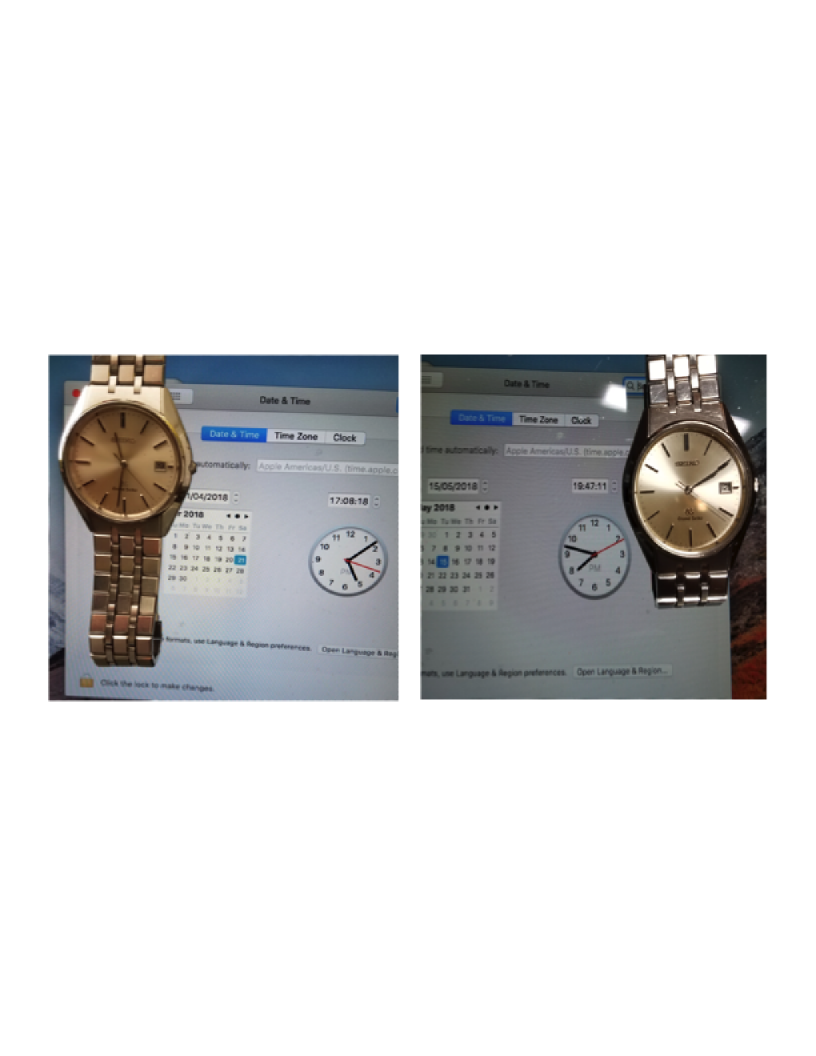
Figure B1: The photos of the 1991 quartz watch together with the screen of our computer, which shows the date and the reading of the world atomic clock. The left panel of Figure B1 shows a photo taken on 21 April 2018 while the photo in the right-panel was taken on 15 May 2018.
Two of the photos are shown in Figure B1. The left panel of Figure B1 shows a photo of the 1991 watch taken on 21 April 2018. Since the tick rates of the two clocks cannot differ by more than 1 minute within several months, we need only focus on reading the seconds. At a moment on 21 April 2018, the world atomic clock read 18 seconds while the quartz watch read 23 seconds. Thus, the quartz watch was offset by a 5 second advance. The right panel of Figure B1 shows a photo taken on 15 May 2018. At a moment on 15 May 2018, the world atomic clock read 11 seconds while the quartz watch read 21 seconds, so the quartz watch was then offset by a 10 second advance. Therefore, within 22 days the world atomic clock slowed by 5 seconds. This result corresponds to the fourth data point in Figure B2b below.
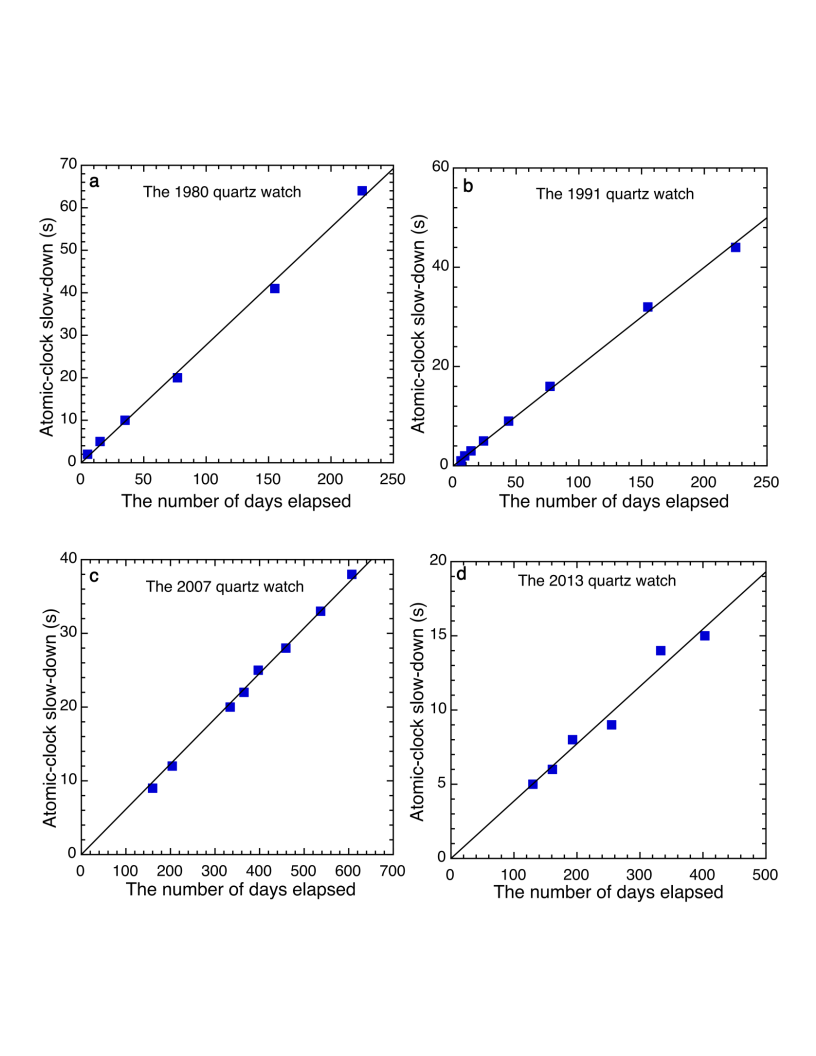
Figure B2: The slow-down times (in seconds) of the world atomic clock compared with the 1980, 1991, 2007, and 2013 quartz watches, respectively. The zero day corresponds to the purchased date of a quartz watch. It is apparent that the slow-down time of the world clock is linearly proportional to the number of days elapsed from the first comparison between the world clock and one of the quartz watches. The maximum deviation from the linear line is less than 2 seconds.
In Figure B2, we plot the slow-down times (in seconds) of the world atomic clock compared with the 1980, 1991, 2007, and 2013 quartz watches, respectively. It is apparent that the slow-down time of the world atomic clock is linearly proportional to the number of days elapsed from the first comparison between the world atomic clock and one of the quartz watches. A linear fit to one set of data points with zero intercept yields the slow-down rate in seconds per day. Multiplying this rate by 365.242 days per year, we obtain the slow-down rate in seconds per year. The fitting parameters and related errors are summarized in Table BII.
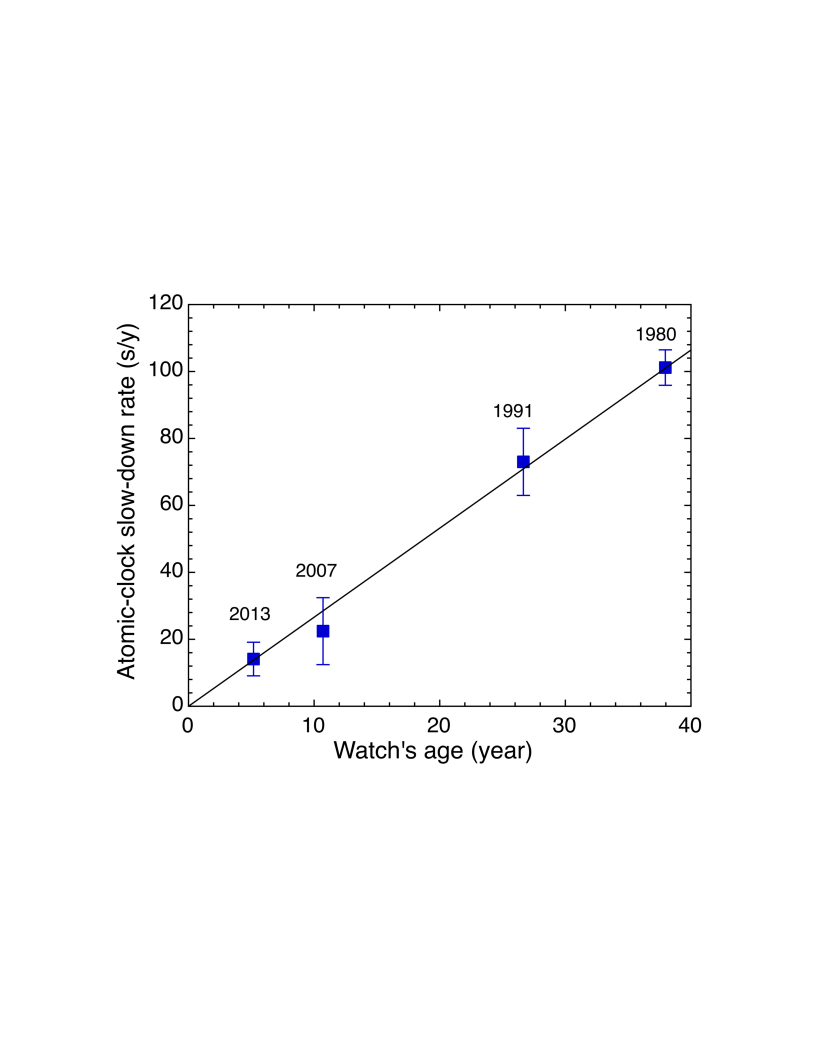
Figure B3: The present slow-down rate (seconds/year) of the world atomic clock compared with the quartz watches of different ages. The age of the watch is the time difference between the present date (corresponding to the middle of the data points in Figure B2) and the manufacture date of the watch. The older the watch is, the faster it runs. Over a period of about 40 years, it follows a linear relationship between the slow-down rate and the age of the watch.
In Figure B3, we plot the present slow-down rate (seconds per year) of the world atomic clock compared with the quartz watches of different ages. The age of the watch is the time difference between the present date (corresponding to the middle of the data points in Figure B2) and the manufacture date of the watch. As discussed above, we expect the tick rate of a quartz watch to freeze in time the tick rate of the world atomic clock at the manufacture date of the quartz watch.
Figure B3 shows that the present tick rate of the world atomic clock slows down by about 100 seconds per year compared with that of the 1980 quartz watch. The older the quartz watch is, the faster it runs. This is the opposite of what one expects from thermodynamics. Over a period of about 40 years, it follows a linear relationship between the slow-down rate and the age of the watch. A linear fit to the data with zero intercept yields a slope of 2.66±0.08 seconds/year2. This means that compared with the quartz watches, the world atomic clock is slowing down by 2.66±0.08 seconds every year or by 84.3±2.5 ppb every year. The fact that all the data points fall on the straight line within the error bars implies that all the quartz watches we have purchased keep the time correctly.
Table BII: The linearly fitted slopes in Figure 2B and other parameters. The age of the watch is calculated from the watch's manufacture date to the present (the middle of the data points in Figure B2). The statistical error σ~st~ is obtained from the linear fitting in Figure B2 and the systematic error σ~sy~ is the rated accuracy of the watch. The total error σ~t~ is calculated according to the formula: $\sigma_{t} = \sqrt{\sigma_{st}{2} + \sigma_{sy}{2}}$. Here, leap second correction is not considered because it is smaller than the reading uncertainty of each data point in Figure B2 (±2 seconds).
| Watch's a | Watch's age (y) Slow-down | Slow-down rate (s/y) σ~st~ (s/ | σ~st~ (s/y) σ~sy~ (s/ | σ~sy~ (s/y) σ~t~ (s/y | σ~t~ (s/y) |
|---|---|---|---|---|---|
| 1 37.96 | 37.96 101.17 | 101.17 1.75 | 1.75 5 | 5 5.30 | 5.30 |
| 2 26.66 | 26.66 73.01 | 73.01 0.76 | 0.76 10 | 10 10.03 | 10.03 |
| 3 10.71 | 10.71 22.44 | 22.44 0.18 | 0.18 10 | 10 10.00 | 10.00 |
| 4 5.18 | 5.18 14.11 | 14.11 0.41 | 0.41 5 | 5 5.02 | 5.02 |
APP-B-S07-TBL-02
Discussion
It is interesting that the most accurate Grand Seiko movement is rated as +4/–2 seconds per year. On the basis of the quadrature error analysis, the asymmetric accuracy specification (+4 vs –2 seconds) suggests a systematic error of +2 seconds per year and random error of ±2 seconds per year. This asymmetric accuracy specification indicates that the world atomic clock should systematically run slower than the quartz watches by about 2 seconds per year, in agreement with our time-keeping result.
After we theoretically proved that the frequency of the Ce-atomic clock is linearly proportional to the speed of light, we decided to compare it with accurate quartz clocks. So we first purchased the 2007 Grand Seiko quartz watch and compared its tick rate with that of the world atomic clock. After we found that the quartz watch ran faster than the world atomic clock, we decided to purchase a newer (2013) and more accurate watch with a rated accuracy of ±5 seconds per year. If our previous conclusion is relevant, the newer quartz watch should also run faster than the world atomic clock, but with a smaller difference. The result indeed came with our expectation. Then we decided to purchase two older watches to further verify our conclusion. But there is a risk that the older watches might not keep the time correctly. Surprisingly, both watches ran faster than the world atomic clock with much larger differences in the tick rates. The linear relation between the slow-down rates and the ages of the watches shown in Figure B3 rules out the possibility that the older watches may not keep the time correctly. The linear relationship also demonstrates the reliability of our time-keeping result.
There are three possible explanations to the current data. The first one is that the atomic clock ticks with a constant rate while the quartz watch runs faster with time. There appears to be no mechanism that could cause Young's modulus and the quartz vibration frequency to increase with time [10,11]. If the frequency of the quartz vibration would keep increasing with time, then phonon energies in a crystal, which are proportional to the vibration frequencies, would keep increasing with time. This violates the law of energy conservation. The aging and radiation effects cause the quartz's frequency to decrease over time [10,11]. We thus discount this interpretation. The second one is that the quartz watch ticks with a constant rate while the atomic clock slows down with time. This is possible if the speed of light is slowing down over time, as predicted from the general theory of relativity and Maxwell's equations (see Introduction above). In this case, the slow-down of the atomic clock implies that the light speed should also slow down by the same rate. The third one is that both the atomic and quartz clocks tick slower over time and the atomic clock slows down with a higher rate than the quartz clock. As discussed above, the aging and radiation effects can cause the quartz's frequency to decrease over time.
Since I = dq/dt and 1/∆t $\propto $c, I = V/R $\propto $c according to the Ohm's law. If c decreases with time, the current expressed in as-maintained ampere is K times smaller than the current expressed in the absolute ampere defined originally. This means that as-maintained ampere is K times larger than the absolute ampere. In the 1960's, several groups underwent different measurements to check a possible shift in as-maintained ampere relative to the absolute ampere A~ABS~, which was set in 1908 at National Physical Laboratory (NPL) of Great Britain by Ayrton, Mather, and Smith (see page 401-428 of Ref. [12]). The apparatus for such an experiment is called a current balance and usually consists of two concentric and coaxial coils with the outer one fixed and the inner one suspended from one arm of a balance beam. Using the NPL current balance, Vigoureux [12] found in 1968 that A~NPL~/A~ABS~ = 1.000 008 6±6.0 ppm, where A~NPL~ is the ampere maintained by NPL. Because the uncertainty is so large, the result is not conclusive.
More accurate measurements of the proton's low-field gyromagnetic ratio γ~p~(low) and the high-field gyromagnetic ratio γ~p~(high) were carried out in Bureau International des Poids et Mesures (BIPM) and also in National Bureau of Standards (NBS). The γ~p~(low) value was determined using γ~p~(low) = ω~p~low/(μ~0~nI~low~), where n is the number of turns per unit length of a coil and I~low~ is the applied current in terms of as-maintained ampere. The γ~p~(high) value was determined using γ~p~(high) = ω~p~high/(F/I~high~L), where F is the force on a conductor carrying the current I~high~ in a field B normal to the conductor's length L (in this case F = I~high~LB). F was determined by balancing with the gravitational force, and its reading was assumed to be time independent. Then γ~p~(low)/γ~p~(high) = (ω~p~low/ω~p~high)F/(μ~0~nLI~low~I~high~) = K2 (since the ratio ω~p~low/ω~p~high is independent of whether the tick rate of a clock is time-dependent or not). The measured values of γ~p~(low)/γ~p~(high) in BIPM and NBS led to K~BIPM~ = A~BIPM~/A~ABS~ = 1.000 011 4±2.7 ppm and K~NBS~ = A~NBS~/A~ABS~ = 1.000 009 0±2.7 ppm, respectively (see page 442 of Ref. [12]). Since I $\propto$ c, the BIPM result implies that c decreases by 11.4±2.7 ppm over the 60-year period between 1908 and 1968. Similarly, the NBS result implies that c decreases by 9.0±2.7 ppm. The average of the two measurements is 10.2±1.5 ppm. Thus, the speed of light should have decreased with a rate of 170±25 ppb per year within the 60-year period between 1908 and 1968.
Because of these results, BIPM and NBS decided that after 1 January 1969, as-maintained ampere and volt were reduced by 11.0 ppm and 8.4 ppm, respectively (see page 442 of Ref. [12]). In 1988, the volt standard was re-examined using a liquid electrometer [13]. On the assumption that g and $\epsilon_{0}$were constants, the determined volt standard was the same as the absolute volt, which discounted the previous reduction of the volt standard in 1969.
If the quartz clock would be time-independent, the tick rate of the atomic clock and thus the speed of light would slow down by 84.3±2.5 ppb per year between 1980 and 2018, which is significantly smaller than 170±25 ppb per year inferred from the experiments on as-maintained electrical units in BIPM and NBS (see above). This difference implies that both atomic and quartz clocks should slow down while the atomic clock slows down with a higher rate than the quartz clock.
The intrinsic slow-down of a quartz clock can be understood by the law of refraction. The quartz's vibration frequency should be proportional to c/n~av~, where n~av~ is the index of refraction averaged over the whole spectrum of the electromagnetic wave. Since dn/df is always positive and f is proportional to c (see Introduction), we have dn/dc > 0 and dn~av~/dc > 0. The relationship: dn~av~/dc > 0 implies that a quartz clock should slow down with a rate smaller than that of an atomic clock, in agreement with the conclusion drawn above from the present and previous experimental results.
Because the measured gravitational wave travels at the same speed as the electromagnetic wave [14] in vacuum and the gravitational force has exactly the same form as the electromagnetic force within the framework of the general theory of relativity, the gravitational constant G should be proportional to 1/$\epsilon_{0}$ $\propto$ c2. This idea is similar to that proposed earlier by Dirac [15]. Since the tick rates of celestial clocks (by the Kepler third law of planetary motion) and pendulum clocks are both proportional to $\sqrt{G}$, they are also linearly proportional to c. When g, Mg, $\epsilon_{0}$, and c are measured using these linearly c-dependent clocks, their measured values are apparently constants. Thus, the physical laws like the theory of general relativity should be still valid when the physical quantities are measured with the linearly c-dependent clocks.
The current cosmological model is based on the theory of general relativity and on the assumption of the constancy of the speed of light. Based on the earth-centered cosmological model we have proposed in Appendix C, we find that the age of the universe is 13.84 billion years, as measured from a moving clock at the boundary of the universe, which is moving away from us with a speed ($v$) close to the speed of light. Due to the time dilation of the moving clock, the age of the universe measured from an observer on the earth (t~0~) is much older than that measured from an observer at the boundary of the universe ($t_{0}'$), that is, t~0~ = $t_{0}'$/(1-($v$/c)2)1/2.
From the relation: $a(t) \propto a'(t') \propto 1/c^{2}$, we can easily show that $\frac{da'}{dt'}/a' =$ $\frac{- 2dc}{dt'}/c$=1/$t_{0}'$. Using $\frac{- dc}{dt'}/c$ = 170±25 ppb per year and t~0~ =13.84 billion years, we obtain $t_{0}'$= 2.94±0.43 million years and $v$ = 0.999 999 98c. Therefore, according to the proper clock our universe is about 3 million years old, and the boundary of the universe is moving with a speed very close to the speed of light.
Conclusion
In summary, we report our time-keeping results for four extremely precise quartz watches of different ages against the world atomic clock. We found that the tick rate of the world atomic clock is slowing down by 84.3±2.5 ppb every year compared with that of the quartz watches. Our data suggest that both the atomic clock and the speed of light should slow down over time, in agreement with the independent experiments on as-maintained electrical units and with the theoretical prediction of both the general theory of relativity and Maxwell's equations. The symmetry of the matter (positive mass) and antimatter (negative mass) [16] ensures energy conservation of the universe independent of whether c is a constant or not.
Acknowledgments:
I would like to thank Dr. Pieder Beeli and Mr. Joshua Zhao for discussion and comment.
References
[1] E. R. Cohen and B. N. Taylor, Rev. Mod. Phys. 59, 1121 (1987).
[2] P. J. Mohr and B. N. Taylor, Rev. Mod. Phys. 72, 351 (2000).
[3] P. J. Mohr, B. N. Taylor, and D. B. Newell, Rev. Mod. Phys. 80, 633 (2008).
[4] P. J. Mohr, D. B. Newell, and B. N. Taylor, Rev. Mod. Phys. 88, 035009 (2016).
[5] C. Møller, The Theory of Relativity (Oxford, Clarendon, 1952).
[6] L. D. Landau and E. M. Lifshitz, The Classical Theory of the Fields, 4th revised English ed. (Oxford: Peramon, 1975).
[7] W. O. Sumner, Astrophys. J. 429, 491 (1994).
[8] https://en.wikipedia.org/wiki/Planck_constant
[9] G. K. Woodgate, Elementary Atomic Structure. Oxford University Press (1999).
[10] J. R. Vig, Introduction to Quartz Frequency Standard, Research and Development Technical Support (SLCET-TR-921), 1992.
[11] C. Frondel, "Effect of Radiation on the elasticity of quartz", (This article is available at the website: http://www.minsocam.org/ammin/AM30/AM30_432.pdf)
[12] B. N. Taylor, W. H. Parker, and D. N. Langenberg, Rev. Mod. Phys. 41, 375 (1969).
[13] W. K. Clothier, G. J. Sloggett, H. Bairnsfather, M. F. Currey, and D. J. Benjamin, Metrologia 26, 9 (1989).
[14] B. P. Abbott et al., Astrophys. J. Lett. 848, L13 (2017).
[15] P. A. M. Dirac, Nature 139, 323 (1937).
[16] J. S. Farnes, Astronomy & Astrophysics, 620, A92 (2018).