The Chronology of the Ancient Near East
The chronology of the ancient Near East provides a framework of dates for various events, rulers and dynasties in Mesopotamia. An absolute chronology for the first millennium BC has been well established because it agrees with some recorded astronomical events. Despite over 100 years of scholarly efforts, only a relative chronology has been established for the third and second millennium BC and their absolute chronology has an uncertainty of over 150 years.
A key document to pin down the absolute chronology is the Venus tablet of Ammisaduqa (king of Old Babylon), the preserved record of astronomical observations of Venus during the reign of Ammisaduqa. Since the conjunction of the rise of Venus occurs periodically, the recorded astronomical observations of Venus can provide possible fixed points of reference. Astronomical calculation has been used to fix the first year of the reign of Hammurabi either as 1848 BC, 1792 BC, 1728 BC, or 1696 BC, depending on whether the high (or long), middle, low (or short), or ultra-short chronology is followed. The differences are 56, 64, and 32 years, respectively, which are multiples of 8. This is because Venus goes around the Sun 13.004 times every 8 years.
Here, we have unambiguously established the absolute chronology from the historically recorded rise of Venus, along with other historically recorded solar and lunar eclipses (see Table III). The second column of Table III is the short chronology established previously by others. Currently most historians accept the middle chronology, which parallelly shifts the regnal periods to the earlier times by 64 years compared to the short chronology. The accurate chronology established here is shown in the 4th column of Table III, which is in perfect agreement with all the recorded astronomical phenomena.
Our current chronology shows that the kingdoms in the Ancient Near East appear to have begun from 2266 BC. There were no detailed historical records before 2266 BC, which can be explained by the fact that Noah's flood (2315-2314 BC) should have destroyed everything in this region. Sargon started to reign in 2241 BC, which was 73 years after the flood. If he came to the throne in his 30's, he should have been born about 40 years after the flood. Because Ham should have begotten Cush right after the flood and Cush should have begotten children about 30-40 years from the flood, Nimrod, a grandson of Ham (Genesis 10:6-8), should have been born about 30-40 years after the flood. Comparing the ages and stories of Nimrod and Sargon, we speculate that they might be the same person with different names. Our speculation is consistent with that of Yigal Levin who published his article "NIMROD THE MIGHTY, KING OF KISH, KING OF SUMER AND AKKAD" in 2002 AD (Vetus Testamentum, Vol. 52, Fasc. 3, 2002, pp. 350-366). The current chronology of the Ancient Near East thus provides an independent proof for the accuracy of the Biblical chronology presented in Chapter 10.
The detailed argument and explanation are given below. If readers want to verify the authenticity of our chronology and have a strong background in science and history, they may continue to read this chapter carefully. Otherwise, they could initially skip the "detailed explanations" below.
Table III: The Chronology of the Ancient Near East (The short chronology in the second column is taken from https://en.wikipedia.org/wiki/Short_chronology)
| Ruler | Reign (Short) | Reign (Ultra-short) | Modified reign (Ultra-short) | Regnal length |
CH07-S01-TBL-01
+:=========================================================+:==================+:==================+:=================================+:==================+
| Lugal-zage-si | 2295–2271 BC | 2263–2239 BC | 2266–2242 BC | 24 |
|---|---|---|---|---|
| Sargon | 2270–2215 BC | 2238–2183 BC | 2241–2186 BC | 56 |
| Rimush | 2214–2206 BC | 2182–2174 BC | 2185–2177 BC | 9 |
| Man-ishtishu | 2205–2191 BC | 2273–2159 BC | 2176–2162 BC | 15 |
| Naram-sin | 2190–2154 BC | 2158–2122 BC | 2161–2125 BC | 37 |
| Shar-kali-sharri | 2153–2129 BC | 2121–2097 BC | 2124–2100 BC | 25 |
| Sarlagab | 2129–2126 BC | 2097–2094 BC | 2100–2097 BC | 3 |
| Shulme | 2126–2120 BC | 2094–2088 BC | 2097–2091 BC | 6 |
| Elulmesh or Silulumesh | 2120–2114 BC | 2088–2082 BC | 2091–2085 BC | 6 |
| Inimabakesh | 2114–2109 BC | 2082–2077 BC | 2085–2080 BC | 5 |
| Igeshaush or Igeaus | 2109–2103 BC | 2077–2071 BC | 2080–2074 BC | 6 |
| Yarlagab or Yarlaqaba | 2103–2088 BC | 2071–2056 BC | 2074–2059 BC | 15 |
| Ibate | 2088–2085 BC | 2056–2053 BC | 2059–2056 BC | 3 |
| Yarlangab or Yarla | 2085–2082 BC | 2053–2050 BC | 2056–2053 BC | 3 |
| Kurum | 2082–2081 BC | 2050–2049 BC | 2053–2052 BC | 1 |
| Apilkin or Habil-kin | 2081–2078 BC | 2049–2046 BC | 2052–2049 BC | 3 |
| La-erabum | 2078–2076 BC | 2046–2044 BC | 2049–2047 BC | 2 |
| Irarum | 2076–2074 BC | 2044–2042 BC | 2047–2045 BC | 2 |
| Ibranum | 2074–2073 BC | 2042–2041 BC | 2045–2044 BC | 1 |
| Hablum | 2073–2071 BC | 2041–2039 BC | 2044–2042 BC | 2 |
| Puzur-Suen | 2071–2064 BC | 2039–2032 BC | 2042–2035 BC | 7 |
| Yarlaganda | 2064–2057 BC | 2032–2025 BC | 2035–2028 BC | 7 |
| Si-um or Si-u | 2057–2050 BC | 2025–2018 BC | 2028–2021 BC | 7 |
| Tirigan | 2050–2050 BC | 2018–2018 BC | 2021–2021 BC | 1 |
| Nammahani | 2049–2046 BC | 2017–2014 BC | 2020–2017 BC | 4 |
| Ur-Namma or Ur-Engur | 2046–2029 BC | 2014–1997 BC | 2017–2000 BC | 17 |
| Shulgi | 2029–1982 BC | 1997–1950 BC | 2000–1953 BC | 47 |
| Amar-Suena | 1981–1973 BC | 1949–1941 BC | 1952–1944 BC | 9 |
| Shu-Suen | 1972–1964 BC | 1940–1932 BC | 1943–1935 BC | 9 |
| Ibbi-Suen | 1963–1940 BC | 1932–1908 BC | 1934–1911 BC | 24 |
| Emisum | 1940–1912 BC | 1908–1980 BC | 1911–1883 BC | 28 |
| Samium | 1912–1877 BC | 1880–1845 BC | 1883–1848 BC | 35 |
| Zabaia | 1877–1868 BC | 1845–1836 BC | 1848–1839 BC | 9 |
| Gungunum | 1868–1841 BC | 1836–1809 BC | 1839–1812 BC | 27 |
| Abisare | 1841–1830 BC | 1809–1798 BC | 1812–1801 BC | 11 |
| Sumuel | 1830–1801 BC | 1798–1769 BC | 1801–1772 BC | 29 |
| Nur-Adad | 1801–1785 BC | 1769–1753 BC | 1772–1756 BC | 16 |
| Sin-Iddinam | 1785–1778 BC | 1753–1746 BC | 1756–1749 BC | 7 |
| Sin-Eribam | 1778–1776 BC | 1746–1744 BC | 1749–1747 BC | 2 |
| Sin-Iqisham | 1776–1771 BC | 1744–1739 BC | 1747–1742 BC | 5 |
| Silli-Adad | 1771–1770 BC | 1739–1738 BC | 1742–1741 BC | 1 |
| Warad-Sin | 1770–1758 BC | 1738–1726 BC | 1741–1729 BC | 12 |
| Rim-Sin I | 1758–1699 BC | 1726–1667 BC | 1729–1670 BC | 59 |
| Hammurabi of Babylon | 1699–1686 BC | 1667–1654 BC | 1670–1657 BC | 13 |
| Samsuiluna of Babylon | 1686–1678 BC | 1654–1646 BC | 1657–1649 BC | 8 |
| Rim-Sin II | 1678–1674 BC | 1646–1642 BC | 1649–1645 BC | 4 |
| Hammurabi | 1728–1686 BC | 1696–1654 BC | 1699–1657 BC | 42 |
| Samsu-iluna | 1686–1648 BC | 1654–1616 BC | 1657–1619 BC | 38 |
| Abi-eshuh or Abieshu | 1648–1620 BC | 1616–1588 BC | 1619–1591 BC | 28 |
| Ammi-ditana | 1620–1583 BC | 1588–1551 BC | 1591–1551 BC | 40 |
| Ammisaduqa | 1582–1562 BC | 1550–1530 BC | 1550–1530 BC | 21 |
| Samsu-Ditana | 1562–1531 BC | 1530–1499 BC | 1530–1493 BC | 37 |
| Mursili I | 1556–1526 BC | 1524–1494 BC | 1524–1493 BC | 31 |
CH07-S01-TBL-02
Detailed explanations
The bold face in Table III highlights the timelines of the kings, which are accurately determined from historically recorded astronomical phenomena including astronomical observations of Venus as well as lunar and solar eclipses.
1. Venus Tablet
The record of astronomical observations of Venus during the reign of Ammisaduqa has been well preserved. The record is difficult to comprehend to those who do not have a strong background in science and history. In the following, we list the detailed record for completeness but only focus on three years (year 1, year 9, and year 17) highlighted by the bold face:
- Year 1 inferior Venus sets on Shabatu [the 11^th^ month] 15 and after 3 days rises on Shabatu 18;
- Year 2 superior Venus vanishes East on Arahsamnu 21 and after 1 month 25 days appears West on Tebetu 16;
- Year 3 inferior Venus sets on Ululu 29 and after 16 days rises on Tashritu 15;
- Year 4 superior Venus vanishes East on Dumuzi 3 and after 2 months 6 days appears West on Ululu 9;
- Year 5 inferior Venus sets on Nisan 29 and after 12 days rises on Ayar 11;
- Year 5 superior Venus vanishes East on Kislimu 27 and after 2 months 3 days appears West on Shabatu 30;
- Year 6 inferior Venus sets on Arahsamnu 28 and after 3 days rises on Kislimu 1;
- Year 7 superior Venus vanishes East on Abu 30 and after 2 months appears West on Tashritu 30;
- Year 8 inferior Venus sets on Dumuzi 9 and after 17 days rises on Dumuzi 26;
- Year 8 superior Venus vanishes East on Adar 27 and after 2 months 16 days appears West on Simanu 13;
- Year 9 inferior Venus sets on Adar [the 12^th^ month] 12 and after 2 days rises on Adar 14;
- Year 10 superior Venus vanishes East on Arahsamnu 17 and after 1 month 25 days appears West on Tebetu 12;
- Year 11 inferior Venus sets on Ululu 25 and after 16 days rises on II Ululu 11;
- Year 12 superior Venus vanishes East on Ayar 29 and after 2 months 6 days appears West on Abu 5;
- Year 13 inferior Venus sets on Nisan 25 and after 12 days rises on Ayar 7;
- Year 13 superior Venus vanishes East on Tebetu 23 and after 2 months 3 days appears West on Adar 26;
- Year 14 inferior Venus sets on Arahsamnu 24 and after 3 days rises on Arahsamnu 27;
- Year 15 superior Venus vanishes East on Abu 26 and after 2 months appears West on Tashritu 26;
- Year 16 inferior Venus sets on Dumuzi 5 and after 16 days rises on Dumuzi 21;
- Year 16 superior Venus vanishes East on Adar 24 and after 2 months 15 days appears West on Simanu 9;
- Year 17 inferior Venus sets on Adar [the 12^th^ month] 8 and after 3 days rises on Adar 11;
- Year 18 superior Venus vanishes East on Arahsamnu 13 and after 1 month 25 days appears West on Tebetu 8;
- Year 19 inferior Venus sets on II Ululu 20 and after 17 days rises on Tashritu 8;
- Year 20 superior Venus vanishes East on Simanu 25 and after 2 months 6 days appears West on Ululu 1;
- Year 21 inferior Venus sets on Nisan 22 and after 11 days rises on Ayar 3;
- Year 21 superior Venus vanishes East on Tebetu 19 and after 2 months 3 days appears West on Adar 22.
If one can explain the observations of Venus in the 1st, 9th and 17th year of Ammisaduqa (see the bolded lines above), one should be able to explain all the other years consistently. These three-year observations of Venus cannot be consistently explained if we use the Babylonian lunisolar calendar established after 700 BC, where the first month always starts on or after the Vernal Equinox. One cannot simultaneously match the records for year 1, year 9, and year 17 if year 0 (the ascension year of king Ammisaduqa), year 8, and year 16 are all regular years with no intercalary month. Only if year 0 is an embolismic year (where an intercalary month is added before year 1 starts) while year 8 and year 16 are regular years, can the records for year 1, year 9, and year 17 agree with the astronomical calculation (see below). It is only possible if the Babylonians in the time of Ammisaduqa used a lunisolar calendar that was similar to the Hebrew lunisolar calendar.
According to the intercalation rule of the Hebrew calendar (see Chapter 2), an intercalary month is added if the time of the full moon after the 12th month falls before the Vernal Equinox. The full moon after the 12th month of 1551 BC was at 23:06 on April 3 of 1550 BC while the Vernal Equinox was at 14:19 on April 4 of 1550 BC. According to the intercalation rule of the Hebrew calendar, a 13th month should have been added for 1551 BC (that is, the year of 1551 BC was an embolismic year). This implies that the year of 1551 BC could have been year 0 of Ammisaduqa. Then the first month of 1550 BC started on April 20 (see Appendix D) when Ammisaduqa should have commenced his first year. In the 18th day of the 11th month of Ammisaduqa's 1st year, which was on 26 February 1549 BC, Venus rose according to the record (year 1), in agreement with the astronomical calculation from the Stellarium Program.
In 1542 BC (8 years after 1550 BC), the Vernal Equinox was at 12:52 on April 4 and the full moon after the 12th month of 1543 BC was at 17:44 on April 5 of 1542 BC. Thus, 1543 BC was a regular year and could have been year 8 of Ammisaduqa. The first month of 1542 BC started in the evening of March 21 (see Appendix D) when Ammisaduqa should have begun his 9th year. In the 14th day of the 12th month of his 9th year, which was on 21 February 1541 BC, Venus rose again according to the record (year 9), which is in perfect agreement with the astronomical calculation from the Stellarium Program (see Figure 2).
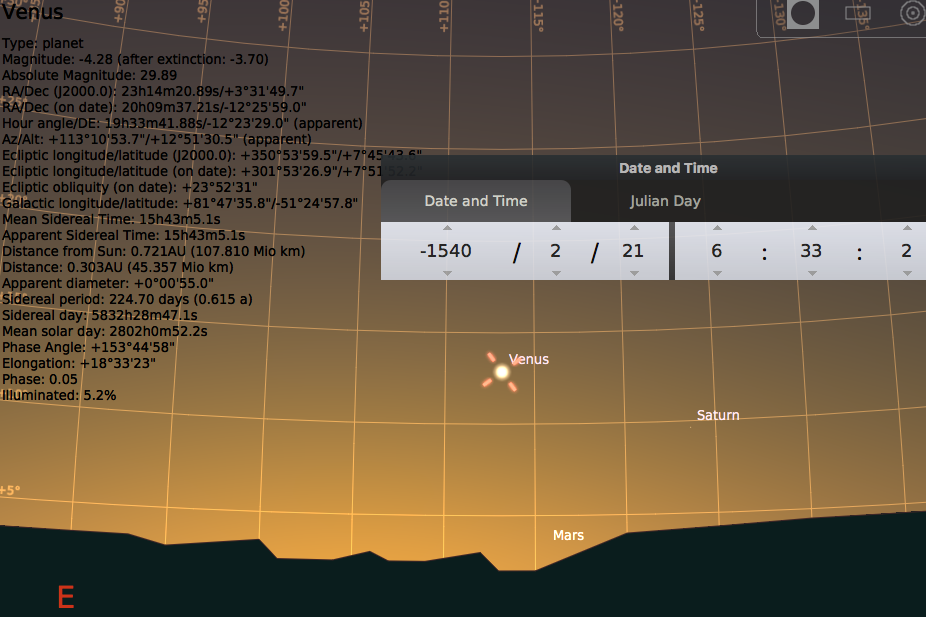
Figure 2: Venus rose on 21 February 1541 BC in Babylon, as predicted from the Stellarium Program.
In 1534 BC (8 years after 1542 BC), the Vernal Equinox was at 5:31 on April 4 and the full moon after the 12th month of 1535 BC was at 12:20 on April 7 of 1534 BC. Therefore 1534 BC was also a regular year and the first month started in the evening of March 23 (see Appendix D) when Ammisaduqa should have started his 17th year. In the 11th day of the 12th month of his 17th year, which was on 22 February 1533 BC, Venus rose again according to the record (year 17), in agreement with the astronomical calculation.
Any backward or forward shift by multiples of 8 years cannot consistently match the recorded Venus rising in year 1, year 9, and year 17 of Ammisaduqa. If the commonly used Babylonian calendar were used to record the Venus rising, no year would have been matched. The recorded astronomical observations of Venus can only be in agreement with the astronomical calculation if the first year of Ammisaduqa was in 1550 BC and the lunisolar calendar used by Ammisaduqa's astronomers was the same as the Hebrew lunisolar calendar first introduced by Moses right after the exodus from Egypt (1457 BC). We thus conclude that the first year of Ammisaduqa must have been in 1550 BC, which confirms the ultra-short chronology listed in Table III.
If the regnal lengths of the kings in the previously established chronology were accurate, the first year of Hammurabi's reign in the ultra-short chronology would be placed in 1696 BC (see the third column of Table III). On the other hand, the recorded lunar eclipse observed in either the 11th or 12th year of Hammurabi (see below) suggests that the first year of Hammurabi should have been between 1697 and 1699 BC. Naturally, this discrepancy can be resolved since the regnal length of Ammi-Ditana was assigned to be 37 years in the previous chronology while his true regnal length was more than 37 years (https://en.wikipedia.org/wiki/Ammi-Ditana). To be consistent with the observed lunar eclipse in the end year of Shulgi (see below), we conclude the first year of Hammurabi to be in 1699 BC, three years earlier than the previously assigned time in the ultra-short chronology.
How would it have been possible for the old Babylonians around 1550 BC to use a lunisolar calendar so like that of the Hebrews? Hammurabi was the sixth king of the First Babylonian Dynasty (https://en.wikipedia.org/wiki/Code_of_Hammurabi). He issued the code of Hammurabi, which he claimed to have received from Shamash, the Babylonian god of justice. The code consisted of 282 laws and was one of the first law codes that emphasized the physical punishment of perpetrators. The code was also one of the earliest examples of "presumption of innocence," where both the accused and accuser had the opportunity to provide evidence.
Scholars have found numerous similarities between the code of Hammurabi and the laws of Moses in the Torah. We do not believe that the Mosaic laws were copied from Hammurabi's code. In all likelihood, both sets of just laws should have been inspired by the same God who is the God of all nations. This same origin explains why the calendar used by the Babylonians during that special period could have been the same as the Hebrew's.
2. Lunar eclipse in the end year of Shulgi
The first lunar eclipse of Ur was described in a tablet (EAE 20). The eclipse was said to take place on the 14th day of the third month, beginning on the first watch in the east, and ending in the west at the beginning of the second watch. The eclipse was thought to mark the end of Shulgi's reign, around 1950 BC, according to the chronology established by the recorded astronomical observations of Venus (see Table III).
The predicted total lunar eclipse on 27 June 1954 BC matches perfectly with the recorded lunar eclipse. The day of 12 June 1954 BC was indeed the 14th day of the third month according to the commonly used Babylonian lunisolar calendar. With a delta-T parameter: ΔT = –20 + 31.1t2 (see Appendix A), the predicted eclipse ended at 22:09.
Since sunset was at 18:50 and sunrise was at 4:44 that day, the first watch started at 18:50; the second watch started at 22:08; and the third watch ended at 4:44 (there were three night-watches for the Babylonians and four night-watches for the Hebrews). Therefore, the predicted lunar eclipse ended at 22:09, which was right at the beginning of the second watch, perfectly matching the recorded lunar eclipse.
Since this lunar eclipse marked the end of the reign of Shulgi, the final year of his reign should have been from the spring of 1954 BC to the spring of 1953 BC. Our chronology listed in Table III (the fourth column) fixes the end of Shulgi's reign in the spring of 1953 BC.
3. Lunar eclipse in the end year of Ibbi-Suen
The second lunar eclipse of Ur was described in EAE 21 and 22. It was said that the eclipse took place on the 14th day of the 12th month, beginning in the first watch in the south, and ending in the last watch in the north. The eclipse was thought to mark the end of the reign of Ibbi-Suen and the end of the Ur III Dynasty. The predicted lunar eclipse on 16 March 1912 BC matches the recorded lunar eclipse. The 16th day of March was on the 14th day of the 12th lunar month of 1913 BC.
From the fitted curve of the delta-T parameter (see Appendix A), we find that the delta-T parameter in 1912 BC is given by ΔT = –20 + 27.8t2. The predicted eclipse has a magnitude of about 1.6, starting at 19:43 and ending at 0:57.
Since sunset was at 17:58 and sunrise was at 6:34 that day, the first watch started from 17:58 and the last watch started at 2:06. The predicted lunar eclipse on 16 March 1912 BC started in the first watch but ended at 0:57, about one hour before the last watch. This small discrepancy between the predicted and observed ending time of the eclipse should be caused by the uncertainty of the delta-T parameter. Indeed, if ΔT = –20 + 32t2 is used, the predicted eclipse started at 20:35 and ended at 1:51. The ending time of the eclipse was only 15 minutes away from the last watch.
The end of the Dynasty of Ur III was in the spring of 1911 BC, according to the chronology in Table III, which was about one year after this recorded lunar eclipse in the spring of 1912 BC.
4. Lunar eclipse in the 11^th^ or 12^th^ year of Hammurabi
A lunar eclipse was recorded in the 11th or 12th year of Hammurabi (Tablet HC-A 25-115) during the Asqudum eponym. Two total lunar eclipses are predicted to occur on February 18 and August 13 of 1687 BC. If the lunar eclipse was seen on 18 February 1687 BC in his 11th year, then his first year was the year between the spring of 1698 BC and the spring of 1697 BC. If the lunar eclipse was seen on 18 February 1687 BC but in the 12th year of Hammurabi's reign, then his first year was the year between the spring of 1699 BC and the spring of 1698 BC. If the lunar eclipse was seen on 13 August 1687 BC in his 11th year, then his first year was the year between the spring of 1697 BC and the spring of 1696 BC. If the lunar eclipse was seen on 13 August 1687 BC but in his 12th year, then his first year was the year between the spring of 1698 BC and the spring of the 1697 BC. The above logical reasoning leads to a conclusion that the first year of Hammurabi should have been between the spring of 1699 and the spring of 1696 BC. In order to match the lunar eclipse in the last year of Shulgi, the first year of Hammurabi should have been the year between the spring 1699 BC and the spring of 1698 BC. Therefore, the lunar eclipse should have been seen on 18 February 1687 BC and in the 12th year of Hammurabi's reign.
5. Solar and lunar eclipses at the end of the First Babylonian Dynasty
Both solar and lunar eclipses were recorded in EAE 20. The eclipses presaged the end of the First Dynasty of Babylon. The lunar eclipse was seen on the 14th day of the 11th month and started in the last watch in the south. It was partially eclipsed in the west. Two weeks later, the solar eclipse was seen on the 28th day of the 11th month.
There are very few pairs of solar and lunar eclipses in the same month. An additional constraint for the pairs of eclipses is that they both occurred in the 11th month and were two weeks apart. A partial lunar eclipse was predicted to be seen on 5 March 1493 BC and exactly two weeks later, a solar eclipse was predicted to be seen in Babylon on 19 March 1493 BC (see Figure 3). The two dates should have been on the 14th and 28th day of the 11th month of 1494 BC, only if the old Assyrian lunisolar calendar was used to record the eclipses. It is likely that the last king of the First Dynasty of Babylon abandoned the previous Hammurabi's code and reverted to the original Assyrian code (including the use of the old Assyrian calendar), leading to the destruction of his kingdom.
Since there are no other eclipse pairs that could have taken place in the 11th month, the predicted and observed eclipse pairs in the 11th month of 1494 BC completely pin down the time for the end of the First Dynasty of Babylon. The final year of the First Dynasty of Babylon should have been from the spring of 1494 BC to the spring of 1493 BC. It was destroyed in the early spring of 1493 BC right after the occurrence of the lunar and solar eclipse pairs.
From the fitted curve of the delta-T parameter (see Appendix A), we find that the delta-T parameter in 1493 BC is given by ΔT = –20 + 25.95t2. Figure 3 shows the occurrence of the maximum solar eclipse at 12:22 on 19 March 1493 BC. The maximum eclipse factor is 41.3%, which is substantial.
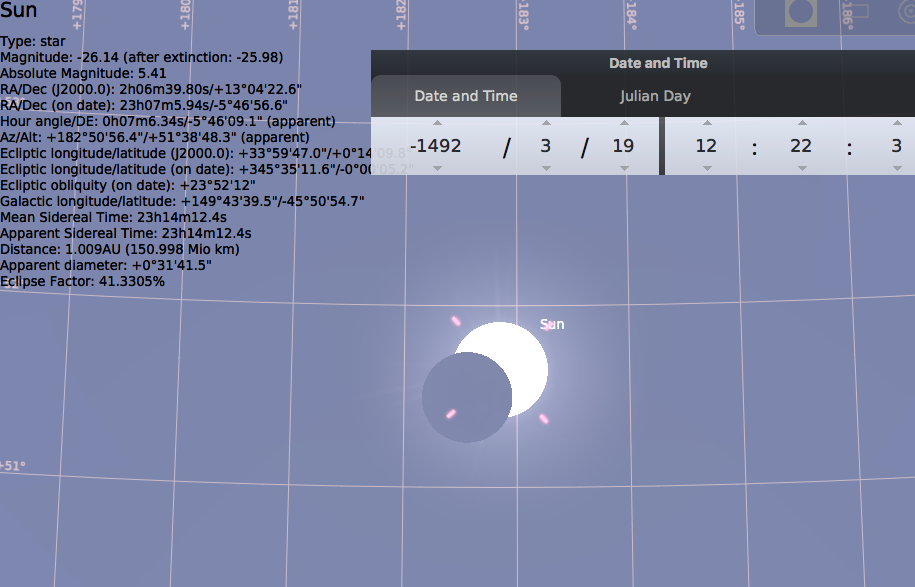
Figure 3: Predicted solar eclipse on 19 March 1493 BC, observed in Babylon.
The predicted lunar eclipse on 5 March 1493 BC has a magnitude of about 1.0. The eclipse started at 2:11 and ended at 6:18 according to the calculation. Since sunset and sunrise on March 5 of 1493 BC were at 17:53 and 6:45, respectively, the third watch should have started at 2:22. Therefore, the starting time (2:11) of the predicted lunar eclipse was very close to the beginning of the last watch, perfectly matching the historical record of the lunar eclipse.
If Babylon fell right after the solar eclipse on 19 March 1493 BC, the last year of Samsu-Ditana was from the spring of 1494 BC to the spring of 1493 BC. Babylon was destroyed in the 12th month of 1494 BC. If this was the case, Samsu-Ditan should have actually reigned for 37 years rather than for 31 years. It is likely that some of the historical records for the latter part of his reign were destroyed after the sacking of Babylon.
According to the short chronology, Mursili I reigned between 1556 and 1526 BC (see the last row of Table III). Within the ultra-short chronology (shifted down by 32 years compared to the short chronology), Mursili I should have reigned between 1524 and 1494 BC instead. It was recorded (see the website: https://en.wikipedia.org/wiki/Mursili_I) that when Mursili I returned to his kingdom after sacking Babylon, he was assassinated in a conspiracy led by his brother-in-law, Hantili I (who took the throne) and Hantili's son-in-law, Zidanta I. This suggests that the city of Babylon should have been destroyed in the last month of 1494 BC if Mursili I reigned until the last month of 1494 BC (the spring of 1493 BC). This is consistent with the conclusion drawn from the recorded eclipse pairs.