Chronology of Judah and Israel's Kings
The Biblical chronology described in Chapter 10 should align perfectly with the chronology of the kings of Israel and Judah if both are accurate. The construction of the latter chronology depends primarily on a series of regnal lengths and cross references within the books of Kings and Chronicles. The ascension of each king is dated in terms of the reign of his contemporary in either the southern kingdom of Judah or the northern kingdom of Israel. The inferred chronology should also align with the chronologies of other ancient civilizations. With this method and some assumptions, Thiele constructed his Biblical chronology, which appears to be accepted by most scholars in this field. Nevertheless, some scholars have maintained that there are weaknesses in his argument such as some unfounded assumptions.
In his desire to resolve the discrepancies between the dates in the books of Kings, Thiele was forced to make some improbable suppositions. Thiele noticed that the cross references given during the long reign of King Asa of Judah had a cumulative error of 1 year for each succeeding reign of the kings of Israel. In order to resolve the discrepancies, he assumed two different methods of reckoning regnal years: the ascension-year method in Judah and non-ascension-year method in Israel. Under the ascension-year method, if a king died in the middle of a year, the period to the end of that year would be called the "ascension year," and year 1 of the new king's reign would begin at the following new year. Under the non-ascension-year method, the ascension year of a new king would be year 1. He further assumed that the northern kingdom used a spring new year while the southern kingdom used a fall new year.
These assumptions do not have a scriptural basis. If all the Hebrew Scriptures are inspired by God and the true author is God, how is it possible for Him to use different reckoning methods for the two kingdoms? The books of Kings were believed to be written by Jeremiah the prophet of God. How could he be so inconsistent in writing about the two kingdoms? Yehowah appointed Nisan 1 as the beginning of a year for the Israelites after He brought them out of Egypt. There is no place in the Hebrew Scriptures where Yehowah would allow the children of Israel to change the first day of a new year.
Biblical method for reckoning regnal years
If all the Hebrew Scriptures are inspired by God, the chronology derived from the books of Kings and Chronicles should be consistent with any other book in the Hebrew Bible and with other reliable historical and astronomical records outside the Bible. Any unreliable and unproved extra-biblical resources cannot be used to support or discredit the conclusion drawn from Biblical evidence. Here, we will construct the chronology of the kings of Israel and Judah based on all the relevant verses in the Hebrew Bible. It is also in perfect agreement with reliable extra-biblical records and astronomical phenomena.
We will first prove that the authors in the books of Kings, Chronicles, and of Jeremiah used an anniversary reckoning method where the regnal years of a king were counted by the anniversaries of his ascension. This method of reckoning regnal years was used in both the northern and southern kingdoms. This anniversary method is inferred from the Scriptures and differs from any method assumed by Thiele. In the cross references, the regnal years of a king are not reckoned from any new year but from the exact ascension date of the referenced king (the anniversary of his ascension). This method does not cause a cumulative error of larger than one year, which allows us to precisely determine the timeline of each king and the total length of each kingdom's lifespan.
How do we know that this is the reckoning method used by the Biblical authors? The reckoning method should not be invented by men, but instead be derived from the Biblical resources. Incredibly, Jeremiah 1 and 52 provide us with this information.
The captivity of Jerusalem took place in the fifth month according to Jeremiah 1:3, "It came also in the days of Jehoiakim the son of Josiah king of Judah, unto the end of the eleventh year of Zedekiah the son of Josiah king of Judah, unto the carrying away of Jerusalem captive in the fifth month." This same event occurred in the eighteenth year of Nebuchadnezzar according to Jeremiah 52:29, "In the eighteenth year of Nebuchadnezzar he carried away captive from Jerusalem eight hundred thirty and two persons." These two verses tell us that Jerusalem's captivity happened in the fifth Hebrew lunar month and in the eighteenth year of Nebuchadnezzar.
Jeremiah also said that Jerusalem and the holy temple were burned down on the 10th day of the fifth Hebrew lunar month in the nineteenth year of Nebuchadnezzar (Jeremiah 52:12). Clearly, there was a day in the fifth month that marked a crossover from the eighteenth to the nineteenth year of Nebuchadnezzar. This crossover day must have been between the first and 10th day of the fifth month and had nothing to do with the Babylonian new-year day. This indicates that Jeremiah used the anniversary method where the regnal years were counted from the anniversary date of Nebuchadnezzar's ascension, which should have been between the first and 10th day of the fifth month.
History indeed tells us that Nebuchadnezzar's father died on the 8th day of the fifth month (August 15) of 605 BC in the Babylonian calendar (ABC 5: Obv. 10), which corresponded to the 10th day of the fifth month in the Hebrew calendar (see the Hebrew calendar of 605 BC in Appendix D). Nebuchadnezzar started his reign just after his father died and the coronation of his kingship was on the first day of the sixth month in the Babylonian calendar (ABC 5: Obv.11). Jeremiah recognized the effective ascension date of Nebuchadnezzar rather than his coronation date.
Having correctly established the reckoning method for regnal years, we can unambiguously prove that the holy temple and Jerusalem were destroyed on the 10th day of the fifth month in the Hebrew calendar and on the anniversary of the nineteenth year of Nebuchadnezzar's reign, which was on 28 July 587 BC (see the Hebrew calendar of 587 BC in Appendix D). Jerusalem was destroyed in 587 BC rather than 586 BC that most Biblical scholars believe.
The Biblical authors did not always follow a chronological order while writing different stories that were supplementary to each other. They usually wrote the main story sequentially to the end. But when they did add a supplementary material to the main story, the time for the supplementary story was often in the middle of the time interval of the main story. Jeremiah followed this writing style. Verses 52:1-14 present a main story about the siege, captivity, and fall of Jerusalem sequentially and verses 52:15-30 provide a supplementary material about the carrying away of Jerusalem captive. After Jeremiah wrapped the main story with the destruction of the holy temple and Jerusalem (verses 12-14), he then provided more detailed information about the carrying away of Jerusalem captive and the temple's articles. The burning down of Jerusalem must have taken place after the articles of the temple were taken away and the people in Jerusalem left the city. The most likely sequence is this: The articles of the temple and the people of Jerusalem were brought to Nebuchadnezzar at Riblah in the beginning of the fifth month, near the end of the 18th year of Nebuchadnezzar; after the execution of some people at Riblah, the holy temple and Jerusalem were burned down by Nebuzaradan, commander of the imperial guard on the 10th day of the fifth month, on the anniversary of the 19th year of Nebuchadnezzar.
Zedekiah became the king of Judah on Adar 3 of 598 BC and was carried into Babylon around the 10th day of the fifth month of 587 BC. Zedekiah reigned 10 years + 6 months +7 days, which are rounded to 11 years, in agreement with Jeremiah 52:1.
Ezekiel the prophet of God also used the same method to reckon the regnal years of a king, as clearly seen from Ezekiel 24:1, "In the ninth year, in the tenth month on the tenth day, the word of Yehowah came to me: 'Son of man, record this date, this very date, because the king of Babylon has laid siege to Jerusalem this very day.'" Here, the year is counted from the exile day of Jehoiachin, the same day that Zedekiah began to reign. The same event was recorded in Jeremiah 52:4, "So in the ninth year of Zedekiah's reign, on the tenth day of the tenth month, Nebuchadnezzar king of Babylon marched against Jerusalem with his whole army. They encamped outside the city and built siege works all around it." This was also recorded in 2 Kings 25:1. Therefore, in the books of Ezekiel, Kings, and Chronicles, the authors used the same reckoning method as the one used by Jeremiah.
Daniel the prophet of God should have used the same reckoning method as Ezekiel because both grew up in Judah and were carried into Babylon in their youth. Both were the prophets of God and were similar in age. Isaiah the prophet of God recorded the same story about Hezekiah king of Judah as that recorded in the books of Kings and Chronicles. It is only natural that Isaiah should have used the same reckoning method as Jeremiah.
Jewish and Christian tradition identified the author of the books of Chronicles as Ezra. Ezra was also believed to be the author of both Chronicles and Ezra–Nehemiah, but later critical scholars abandoned the books' identification with Ezra and called the anonymous author "the Chronicler." One of the most striking, although inconclusive, features of Chronicles is that its closing sentence is repeated as the opening of Ezra–Nehemiah. If the same author wrote the books of Chronicles, Ezra, and of Nehemiah, we expect that the author should have used the same reckoning method as Jeremiah. This should be the case because the true author of all these Biblical books is God.
Now let us test the above hypothesis. Nehemiah 1:1 and 2:1 show that the month of Kislev (the 9th month) preceded Nisan in the 20th year of Artaxerxes I, and Ezra 7:7-9 shows that Nisan preceded Av (the 5th month) in the 7th year of Artaxerxes I, so that the turning point from one regnal year of Artaxerxes I to another should have occurred between Av and Kislev. If one would use the ascension-year reckoning method, the Persians would have started their new year in the fall, which contradicts the fact that the ancient Persians and Babylonians always started their new year in the spring. Yehowah never allows His servants to write something without respecting facts. In order to be consistent with the anniversary reckoning method used by Jeremiah, Artaxerxes I must have started to reign in the fall. The chronology of Babylonian and Persian kings shown in Chapter 8 indeed shows that Artaxerxes I came to the throne in the 7th month of 464 BC. This further proves that God consistently used the same reckoning method in His inspired books.
Method for reckoning regnal years in Josephus' works
Josephus the Jewish historian of the first century AD appears to have also used the anniversary reckoning method in his account of the Jewish War: "This defeat [of Cestius] happened on the eighth day of the month Dius [Marchesvan/the eighth month] in the twelfth year of the reign of Nero." (Wars, bk. 2, ch.19, sect. 9).
It is known that the Roman emperor Claudius was poisoned to death on 13 October 54 AD, which is on the 22nd of Hyperberetaios [Tishri/the seventh month]. If Nero would have come to the throne immediately after the death of Claudius, the defeat of Cestius would not have been in the twelfth year of Nero if counted using the anniversary or non-ascension-year method. The ascension-year method would have been valid in this case but cannot simultaneously explain Josephus' other account: "the second temple was destroyed in Vespasian's second year." (Wars, bk. 6, ch. 4, 269). Vespasian was proclaimed emperor by his troops in July of 69 AD and Jerusalem was destroyed on August 5 of 70 AD, which would be in the first year of Vespasian if counted using the ascension-year method.
If we assume that Nero came to the throne after 8 Marchesvan (the 8th month) 54 AD, over 2 weeks after the death of Claudius, we can consistently explain all the accounts of Josephus using the anniversary reckoning method. This assumption may be supported by the historical fact told by Richard Cavendish (History Today, Vol. 54, Issue 10, 2004):
This passage suggests that Nero may have waited over 2 weeks to find an astrologically favorable moment for his ascension. Thus, he may have started his reign after 8 Marchesvan 54 AD.
In summary, all the Biblical writers of the Hebrew Bible and the Jewish historian Josephus have consistently used the anniversary reckoning method to count regnal years of the kings. With the anniversary reckoning method, we are able to construct the chronology of Judah and Israel's kings accurately.
Relative chronology of Judah and Israel's kings
In Table VIII below, we present the relative chronology of Judah and Israel's kings. The chronology is relative to the time when the united kingdom of Israel was divided into the southern kingdom Judah with two tribes (Judah and Benjamin) and the northern kingdom Israel with 10 tribes. We set this time to 0. The letter "F" in the table means "Fall" season (after the Summer Solstice) and the letter "S" means "Spring" season (before the Summer Solstice). The first number inside parenthesis after each king's name marks his regnal length. Half a year or more is rounded to one year and less than half a year is rounded to 0. The second part inside parenthesis is an abbreviated king's name along with an ordinal number "x", meaning that the current king started to reign in the "xth" year of the cross-referenced king. For example, Asa's information (41, Jer20) indicates that King Asa started to reign in the 20th year of Jeroboam, which was abbreviated with "Jer" to save space, and that he reigned for 41 years. "In the 20th year of Jeroboam" means that he had reigned for more than 19 and less than 20 years, depending on whether the time is in the beginning or the end of the year. Some negative numbers are for reference to the reign of a future king. The second parenthesis provides the references for the Biblical verses. In most cases, the uncertainty is less than half a year.
The relative chronology is internally consistent. The rows with bold face mean that the king started to reign solely. The regnal length of a king is calculated from the beginning of his reign (or co-reign) to the end when the following king starts to reign solely. With co-regency, the regnal length of each king matches the chronology very well. We describe these co-regency periods in detail as follows: Nadab started to reign at 22S and his reign ended at 24S when Baasha started to reign solely; Baasha started to co-reign with Nadab at 23S and ended his reign at 47S when Elah started to reign solely; Omri started to co-reign with Elah at 47S and ended his reign at 58F when Ahab started to reign solely; Jehoshaphat started to co-reign with Asa and ended his reign at 83S when Jehoram started to reign solely (Jehoram might have co-reigned with Jehoshaphat at 78S for a very short time and been removed by his father); Ahab started to reign at 56S and ended his reign at 77F when Ahaziah started to reign; Jehoahaz started to reign at 120F and ended his reign at 137S when Jehoash started to reign solely; Jehoash started to co-reign with Jehoahaz at 134S and ended his reign at 149F when Jeroboam II started to reign solely; Joash started to reign at 98S and ended his reign at 138S when Amaziah started to reign solely; Amaziah started to co-reign with Joash at 135F and ended his reign at 164F when Azariah started to reign solely; Azariah started to co-reign with Amaziah at 140F and ended his reign when Jotham started to reign at 192F; Jotham started to reign at 192F and ended his reign at 208F when Ahaz started to reign solely; Ahaz started to co-reign with Jotham at 199F and ended his reign at 215S when Hezekiah started to reign solely; Hezekiah started to co-reign with Ahaz at 214F and ended his reign at 244S when Manasseh started to reign.
| Judah (and Benjamin) **Israel | Israel (Ten Northern Tribes) |
|---|---|
| Rehoboam (17) (1 Kings 14:21[]{.indexref entry="1 Kings 14\:21"}) 0F 0F Jerobo | 0F Jeroboam I (22) (1 Kings 14:20[]{.indexref entry="1 Kings 14\:20"}) |
| Abijah (3, Jer18) (1 Kings 15:1[]{.indexref entry="1 Kings 15\:1"}) 17F | |
| Asa (41, Jer20) (1 Kings 15:9[]{.indexref entry="1 Kings 15\:9"}) 20F | |
| 22S Nadab | 22S Nadab (2, Asa2) (1 Kings 15:25[]{.indexref entry="1 Kings 15\:25"}) |
| 23S Baash | 23S Baasha (24, Asa3) (1 Kings 15:33[]{.indexref entry="1 Kings 15\:33"}) |
| **24S Baa | 24S Baasha (24, Asa4) |
| 46S Elah | 46S Elah (2, Asa26) (1 Kings 16:8[]{.indexref entry="1 Kings 16\:8"}) |
| **47S Ela | 47S Elah (2, Asa27) |
| 47S Omri | 47S Omri (12, Asa27) (1 Kings 16:23[]{.indexref entry="1 Kings 16\:23"}) |
| **47F Omr | 47F Omri (12, Asa27) |
| 56S Ahab | 56S Ahab (22) (1 Kings 16:29[]{.indexref entry="1 Kings 16\:29"}) |
| Jehoshaphat (25, Asa37) 58S | |
| **58F Aha | 58F Ahab (22, Asa38) (1 Kings 16:29[]{.indexref entry="1 Kings 16\:29"}) |
| Jehoshaphat (25, Ahab4) (1 Kings 22:41-42[]{.indexref entry="1 Kings 22\:41-42"}) 61F | |
| 77F Ahazi | 77F Ahaziah (2, Jehos17) (1 Kings 22:51[]{.indexref entry="1 Kings 22\:51"}) |
| Jehoram (unknown, Jor-2) (2 Kings 1:17[]{.indexref entry="2 Kings 1\:17"}) 78S | |
| 79S Joram | 79S Joram (12, Jehos18) (2 Kings 3:1[]{.indexref entry="2 Kings 3\:1"} & 1:17[]{.indexref entry="2 Kings 1\:17"}) |
| Jehoram (8, Jor5) (2 Kings 8:16[]{.indexref entry="2 Kings 8\:16"}) 83S | |
| Ahaziah (1, Jor12) (2 Kings 9:29[]{.indexref entry="2 Kings 9\:29"} & 8:25[]{.indexref entry="2 Kings 8\:25"}) 91S | |
| Athaliah (6) (2 Kings 9-10[]{.indexref entry="2 Kings 9-10"}; 11:1-4[]{.indexref entry="2 Kings 11\:1-4"}) 92F 92F Jesu | 92F Jesu (28) (2 Kings 9-10[]{.indexref entry="2 Kings 9-10"}) |
| Joash (40, Jesu7)(2 Kings 12:1[]{.indexref entry="2 Kings 12\:1"}) 98S | |
| 120F Jeho | 120F Jehoahaz (17, Joash23) (2 Kings 13:1[]{.indexref entry="2 Kings 13\:1"}) |
| 134S Jeho | 134S Jehoash (16, Joash37) (2 Kings 13:10[]{.indexref entry="2 Kings 13\:10"}) |
| Amaziah (29, Jehoash2) (2 Kings 14:1-2[]{.indexref entry="2 Kings 14\:1-2"}) 135F | |
| **137S Je | 137S Jehoash (16, Joash40) |
| 137F Jero | 137F Jeroboam II (41) (2 Kings 15:1[]{.indexref entry="2 Kings 15\:1"}) |
| Amaziah (29, Jehoash2) 138S | |
| Azariah (52, Zech-38) (2 Kings 15:8[]{.indexref entry="2 Kings 15\:8"}) 140F | |
| **149F Je | 149F Jeroboam II (41, Ama15) (2 Kings 14:23) |
| Azariah (Jerob27) (2 Kings 15:1[]{.indexref entry="2 Kings 15\:1"}) 164F | |
| 178F Zech | 178F Zechariah (0.5, Jerob41) (2 Kings 14:23[]{.indexref entry="2 Kings 14\:23"}) |
| 179S Mena | 179S Menahem (10, Aza39) (2 Kings 15:17[]{.indexref entry="2 Kings 15\:17"}) |
| 189F Peha | 189F Pehakian (2, Aza50) (2 Kings 15:23[]{.indexref entry="2 Kings 15\:23"}) |
| 191F Peka | 191F Pekah (20, Aza52) (2 Kings 15:27[]{.indexref entry="2 Kings 15\:27"}) |
| Jotham (16, Pekah2) (2 Kings 15:32-33[]{.indexref entry="2 Kings 15\:32-33"}) 192F | |
| Ahaz (16, Hos-12) (2 Kings 17:1[]{.indexref entry="2 Kings 17\:1"}) 199F | |
| Ahaz (16, Pekah17) (2 Kings 16:1[]{.indexref entry="2 Kings 16\:1"}) 208F | |
| 211F Hosh | 211F Hoshea (9, Joth20) (2 Kings 15:30[]{.indexref entry="2 Kings 15\:30"}) |
| Hezekiah (29, Hos3) (2 Kings 18:1-2[]{.indexref entry="2 Kings 18\:1-2"}) 214F | |
| Hezekiah (29) (2 Chron. 29:1[]{.indexref entry="2 Chronicles 29\:3"}) 215S | |
| 220F Sama | 220F Samaria fell (Hos9, Hez6) (2 Kings 17:6[]{.indexref entry="2 Kings 17\:6"}; 18:10[]{.indexref entry="2 Kings 18\:10"}) |
| Manasseh (55) (2 Kings 21:1[]{.indexref entry="2 Kings 21\:1"}) 244S | |
| Amon (2) (2 Kings 21:19[]{.indexref entry="2 Kings 21\:19"}) 299S | |
| Josial (31) (2 Kings 22:1[]{.indexref entry="2 Kings 22\:1"}) 301S | |
| Jehoiakim (11) (2 Kings 23:36[]{.indexref entry="2 Kings 23\:36"}) 332S | |
| Zedekiah (11) (2 Kings 24:18[]{.indexref entry="2 Kings 24\:18"}) 344S | |
| Jerusalem fell (Neb19) (2 Kings 25:8[]{.indexref entry="2 Kings 25\:8"}) 354F |
CH11-S04-TBL-01
Absolute chronology of Judah and Israel's kings
In Table IX, we present the absolute chronology by fixing the time of the destruction of Jerusalem to be the fall of 587 BC (which is written as 587F in Table IX to save space). The chronology is consistent with all the Biblical verses without any adjustment. Thiele adjusted his chronology by comparing some extra-biblical events, which have not been proved to be reliable. Here, we only compare it with reliable extra-biblical chronologies. What is so amazing is that they are in perfect agreement with each other.
Since Solomon had reigned for 40 years before Rehoboam started to reign in the fall of 941 BC, he started his reign in the fall of 981 BC. In his 4th year and in the spring of 977 BC, he started to build the holy temple. From the time when Solomon started to build the temple to the time when Jerusalem was destroyed, there were 390 years.
| Judah (and Benjamin) **Israel | Israel (Ten Northern Tribes) |
|---|---|
| Rehoboam (17) (1 Kings 14:21[]{.indexref entry="1 Kings 14\:21"}) 941F 941F Jero | 941F Jeroboam I (22)(1 Kings 14:20[]{.indexref entry="1 Kings 14\:20"}) |
| Abijah (3, Jer18) (1 Kings 15:1[]{.indexref entry="1 Kings 15\:1"}) 924F | |
| Asa (41, Jer20) (1 Kings 15:9[]{.indexref entry="1 Kings 15\:9"}) 921F | |
| 919S Nada | 919S Nadab (2, Asa2) (1 Kings 15:25[]{.indexref entry="1 Kings 15\:25"}) |
| 918S Baas | 918S Baasha (24, Asa3) (1 Kings 15:33[]{.indexref entry="1 Kings 15\:33"}) |
| **917S Ba | 917S Baasha (24, Asa4) |
| 895S Elah | 895S Elah (2, Asa26) (1 Kings 16:8[]{.indexref entry="1 Kings 16\:8"}) |
| **894S El | 894S Elah (2, Asa27) |
| 894S Omri | 894S Omri (12, Asa27) (1 Kings 16:23[]{.indexref entry="1 Kings 16\:23"}) |
| **894F Om | 894F Omri (12, Asa27) |
| 885S Ahab | 885S Ahab (22) (1 Kings 16:29[]{.indexref entry="1 Kings 16\:29"}) |
| Jehoshaphat (25, Asa38) 883S | |
| **883F Ah | 883F Ahab (22, Asa38) (1 Kings 16:29[]{.indexref entry="1 Kings 16\:29"}) |
| Jehoshaphat (25, Ahab4) (1 Kings 22:41-42[]{.indexref entry="1 Kings 22\:41-42"}) 880F | |
| 864F Ahaz | 864F Ahaziah (2, Jehos17) (1 Kings 22:51[]{.indexref entry="1 Kings 22\:51"}) |
| Jehoram (unknown, Jor-2) (2 Kings 1:17[]{.indexref entry="2 Kings 1\:17"}) 863S | |
| 862S Jora | 862S Joram (12, Jehos18) (2 Kings 3:1[]{.indexref entry="2 Kings 3\:1"} & 1:17[]{.indexref entry="2 Kings 1\:17"}) |
| Jehoram (8, Jor5) (2 Kings 8:16[]{.indexref entry="2 Kings 8\:16"}) 858S | |
| Ahaziah (1, Jor12) (2 Kings 9:29[]{.indexref entry="2 Kings 9\:29"} & 8:25[]{.indexref entry="2 Kings 8\:25"}) 850S | |
| Athaliah (6) (2 Kings 9-10[]{.indexref entry="2 Kings 9-10"}; 11:1-4[]{.indexref entry="2 Kings 11\:1-4"}) 849F 839F Jesu | 839F Jesu (28) (2 Kings 9-10[]{.indexref entry="2 Kings 9-10"}) |
| Joash (40, Jesu7) (2 Kings 12:1[]{.indexref entry="2 Kings 12\:1"}) 843S | |
| 821F Jeho | 821F Jehoahaz (17, Joash23) (2 Kings 13:1[]{.indexref entry="2 Kings 13\:1"}) |
| 807S Jeho | 807S Jehoash (16, Joash37) (2 Kings 13:10[]{.indexref entry="2 Kings 13\:10"}) |
| Amaziah (29, Jehoash2) (2 Kings 14:1-2[]{.indexref entry="2 Kings 14\:1-2"}) 806F | |
| **804S Je | 804S Jehoash (16, Joash37) |
| 794F Jero | 794F Jeroboam II (41) (2 Kings 15:1[]{.indexref entry="2 Kings 15\:1"}) |
| Amaziah (29, Jehoash2) 803S | |
| Azariah (52, Zech-38) (2 Kings 15:8[]{.indexref entry="2 Kings 15\:8"}) 801F | |
| **792F Je | 792F Jeroboam II (41, Ama15) (2 Kings 14:23[]{.indexref entry="2 Kings 14\:23"}) |
| Azariah (Jerob27) (2 Kings 15:1[]{.indexref entry="2 Kings 15\:1"}) 777F | |
| 763F Zech | 763F Zechariah (0.5, Jerob41) (2 Kings 14:23[]{.indexref entry="2 Kings 14\:23"}) |
| 762S Mena | 762S Menahem (10, Aza39) (2 Kings 15:17[]{.indexref entry="2 Kings 15\:17"}) |
| 752F Peha | 752F Pehakian (2, Aza50) (2 Kings 15:23[]{.indexref entry="2 Kings 15\:23"}) |
| 750F Peka | 750F Pekah (20, Aza52) (2 Kings 15:27[]{.indexref entry="2 Kings 15\:27"}) |
| Jotham (16, Pekah2) (2 Kings 15:32-33[]{.indexref entry="2 Kings 15\:32-33"}) 749F | |
| Ahaz (16, Hos-12) (2 Kings 17:1[]{.indexref entry="2 Kings 17\:1"}) 742F | |
| Ahaz (16, Pekah17) (2 Kings 16:1[]{.indexref entry="2 Kings 16\:1"}) 733F | |
| 730F Hosh | 730F Hoshea (9, Joth20) (2 Kings 15:30[]{.indexref entry="2 Kings 15\:30"}) |
| Hezekiah (29, Hos3) (2 Kings 18:1-2[]{.indexref entry="2 Kings 18\:1-2"}) 727F | |
| Hezekiah (29) (2 Chron. 29:1[]{.indexref entry="2 Chronicles 29\:3"}) 726S | |
| 721F Sama | 721F Samaria fell (Hos9, Hez6) (2 Kings 17:6[]{.indexref entry="2 Kings 17\:6"}; 18:10[]{.indexref entry="2 Kings 18\:10"}) |
| Manasseh (55) (2 Kings 21:1[]{.indexref entry="2 Kings 21\:1"}) 697S | |
| Amon (2) (2 Kings 21:19[]{.indexref entry="2 Kings 21\:19"}) 642S | |
| Josial (31) (2 Kings 22:1[]{.indexref entry="2 Kings 22\:1"}) 640S | |
| Jehoiakim (11) (2 Kings 23:36[]{.indexref entry="2 Kings 23\:36"}) 609S | |
| Zedekiah (11) (2 Kings 24:18[]{.indexref entry="2 Kings 24\:18"}) 597S | |
| Jerusalem fell (Neb19) (2 Kings 25:8[]{.indexref entry="2 Kings 25\:8"}) 587F |
CH11-S06-TBL-02
Starting to build Solomon's temple
Solomon began to build the temple in the fourth year of his reign, on the second day of the second month, four hundred and eighty years after the exodus of the Israelites out of Egypt (1 Kings 6:1, 2 Chronicles 3:2). As discussed above, Solomon started to build the temple in the spring of 977 BC (in the second day of the second month), which was on 16 April 977 BC. In the 8th month of his 11th year (970 BC), he finished all the detailed works (1 Kings 6:38). After this, Solomon ministered to make various temple articles. About one year later, he assembled the elders of Israel, heads of the tribes, and the chief fathers of children of Israel, and brought up the ark of the Covenant of Yehowah from the city of David. He dedicated to the temple in the 7th month of 969 BC (1 Kings 6:38, 1 Kings 8:1-2). The dedication of the temple marked the date in which the holy temple was built.
This magnificent event which lasted for three weeks should have been well known to all the neighboring countries. Consequently, the date of the 7th month of 969 BC should have been remembered or recorded by the historians both inside and outside Israel.
Josephus stated: "Let me now pass from these to some Phoenician records concerning our nation and present the evidence drawn from them. Among the Tyrians there are exact public records going back many years, about matters of significance done by them or with each other. It is recorded there that the temple was built by King Solomon in Jerusalem a hundred and forty-three [143] years and eight months before the Tyrians built Karchedon [Carthage]" (Against Apion, bk. 1, 106-108). Adding a hundred and forty-three years and eight months to the 7th month of 969 BC yields the 4th month of 825 BC, the date in which the Tyrians built Carthage.
Indeed, the date of the founding of Carthage was 825 BC, which was synchronized (https://en.wikipedia.org/wiki/King_of_Tyre) with an Assyrian record (tribute of Baal-Eser II/Balazeros II to Shalmaneser III in 841 BC) and with the founding of Rome. Pompeius Trogus, a Gallo-Roman historian who lived during the reign of Emperor Augustus, placed the founding of Carthage or Dido's flight from her brother Pygmalion in the seventh year of Pygmalion, and 72 years before the founding of Rome.
At least as early as the first century BC and later, the date most commonly used by Roman writers for the founding of Rome was on 21 April 753 BC. This places the founding of Carthage in 825 (753 + 72) BC. Therefore, our chronology is in perfect agreement with the extra-biblical records.
Sennacherib's attack on Judah
Sennacherib started to attack the fortified cities of Judah in the 14th year of Hezekiah king of Judah (2 Kings 18:13). Hayim Tadmor wrote an article about the last stage of Sargon's military activities in Philistia, which provides an important insight into the beginning year of Sennacherib's attack on the fortified cities of Judah. He wrote in "Philistia under Assyrian Rule" [The Biblical Archaeologist, Vol. 29, No. 3 (Sept. 1966), pp. 86-102]:
These passages suggest that Azekah was the first city of Judah that the Assyrians attacked in 712 BC, which was in the 14th year of Hezekiah's sole reign according to our chronology above, in agreement with 2 Kings 18:13 and 2 Chronicles 32:1. Since Sargon king of Assyrian was making war against Ashdod in 712 BC, he would not have been able to simultaneously attack Judah to prevent Hezekiah from aiding Ashdod. Therefore, in all likelihood, Sennacherib, the crown prince of Assyria at that time, launched the attack on Azekah and other cities in Judah.
Although Sennacherib was a crown prince at that time, the title of king in the Biblical text could have referred to Sennacherib's future royal title. This can be seen from other Biblical texts concerning Tiglath-Pileser king of Assyria. Before Tiglath-Pileser became king of Assyria, he was a commander and his name was Pul, but the Biblical author called him king of Assyria (2 Kings 15:19,29). There is another example. During the Sennacherib's campaign against Jerusalem, the Scripture says (2 Kings 19:9): "And when he heard concerning Tirhakah king of Ethiopia..." At that time (702 BC), Tirhakah was only a military commander, and he came to the throne over 10 years later (690 BC).
Sennacherib started to attack the fortified cities of Judah in the spring of 712 BC and captured all the fortified cities except for Jerusalem. Hezekiah decided to defend it by counseling with his princes and mighty men to stop the waters from the fountains which were outside the city, by building up the wall that was broken, raising it up to the towers and another wall outside, and repairing Millo in the city of David, and making weapons and shields in abundance (2 Chronicles 32:2-8). It is possible that Sennacherib was unable to take Jerusalem for many years because Hezekiah and the people of Jerusalem repented of the pride of their hearts and Yehowah's protection was still with Jerusalem during the days of Hezekiah (2 Chronicles 32:26).
The pride of Hezekiah's heart was revealed when the ambassadors of the princes of Babylon were sent unto him to inquire of the wonder (Yehowah's miraculous sign and healing) that was done in the land (2 Chronicles 32:31) and Hezekiah showed them all that was in his storehouses—the silver, the gold, the spices and the fine olive oil—his armory and everything found among his treasures. Because Hezekiah did not follow God more closely according to the benefit God did unto him and his heart was lifted up, there was wrath upon him, and upon Judah and Jerusalem (2 Chronicles 32:31). Because of His wrath, God stirred up the heart of Sennacherib to attack the fortified cities of Judah in the spring of 712 BC after the ambassadors of the princes of Babylon visited Hezekiah.
Hezekiah's illness and Yehowah's miraculous healing should have occurred during the end of the 14th year of his sole reign, which was in the spring of 712 BC. This is because his lifespan was extended for 15 years more after the healing (2 Kings 20:6) and his regnal length was 29 years (2 Kings 18:2). Because his heart was proud after Yehowah had done so many favors to him, God was angry with him, leaving and testing him (2 Chronicles 32:31). This raises a high possibility that the initial invasion of Judah by Sennacherib in the spring of 712 BC occurred right after Hezekiah's illness, which also took place in the spring of 712 BC. To humble Hezekiah, Yehowah immediately stirred up the heart of Sennacherib to attack Judah. This is consistent with the pattern of Yehowah's hands, as seen in many other cases (e.g., 2 Chronicles 28:19-20).
As we mentioned before, the Biblical authors often do not follow a chronological time sequence when they write different stories supplementary to each other. Here, we see another example. For the main story of Hezekiah, the Bible starts with 2 Kings 18:1 which says about the first year of Hezekiah's sole reign (from the spring of 726 BC). It continues and finishes the main story until the death of Sennacherib (681 BC). The supplementary story of Hezekiah starts from 2 Kings 20:1, which says "In those days" rather than "Then." The phrase "in those days" means any time during the reign of Hezekiah. Since this supplementary story is very important, it deserves a separate section to describe in length. If this section were to be part of the main story, it would greatly distract the readers. With this writing style, readers might misunderstand the time sequence if they would not meditate on the verses carefully. Yehowah desires His children to read His Word seriously and carefully and to obey His Word with all their hearts.
After 2 Kings 18:13 tells us that Sennacherib began to assault the fortified cities of Judah in the 14th year of Hezekiah (in the spring of 712 BC when Sennacherib was a crown prince), the following verse (2 Kings 18:14) jumps to the story after Sennacherib became king and tried to attack Jerusalem in his third campaign (702 BC). The story appeared to jump so suddenly, but it was quite normal for Biblical writing. Another sudden jump in the story can be found in 2 Kings 19:36-37. Verse 36 tells a story about Sennacherib's withdrawal to Nineveh in 702 BC (the fourth year of his reign) while the following verse says that he was killed by his son in 681 BC, the end year of his reign. With this compact writing style, the author only briefly recorded a few major events regarding the king.
The story described in 2 Kings 18:14-16 must have happened after Hezekiah showed the Babylonians all the treasures in his palace in the spring of 712 BC. Verse 16 tells us that Hezekiah had to strip off the gold with which he had covered the doors and doorposts of the temple of Yehowah, in order to be able to pay the full tribute imposed by Sennacherib. This verse implies that Hezekiah did not have gold in his storehouses, which made it impossible for him to show off his wealth if the Babylonians had visited him after this campaign. This campaign was generally believed to take place in 701 BC, but by carefully comparing the Chronicle on the Reigns from Nabû-Nasir to Šamaš-šuma-ukin (ABC 1), Assysian Eponyn List, the first edition of BM 113203 cylinder, the Sennacherib prism, and the Biblical account, we conclude that this campaign should have occurred in 702 BC. Independent of whether the campaign took place in 701 BC or 702 BC, it definitely happened after Hezekiah's illness, in agreement with the Biblical record.
Battle of Qarqar not related to King Ahab
The inscription on the Shalmaneser III Stela deals with campaigns Shalmaneser made in western Mesopotamia and Syria, fighting extensively with the countries of Bit Adini and Carchemish (https://en.wikipedia.org/wiki/Kurkh_Monoliths). At the end of the Monolith comes the account of the Battle of Qarqar in 853 BC, where an alliance of twelve kings fought against Shalmaneser at the Syrian city of Qarqar. This alliance, comprised of eleven kings, was led by Irhuleni of Hamath, Hadadezer of Damascus, and a large force led by King A-ha-ab-bu of Sir-ila-a-a.
The identification of "A-ha-ab-bu Sir-ila-a-a" with "Ahab of Israel" was first proposed by Julius Oppert in his 1865 "Histoire des Empires de Chaldée et d'Assyrie." If this identification were relevant, Ahab would have been still alive in 853 BC and Hadadezer of Damascus would have formed an alliance with Ahab of Israel, although they had been bitterly hostile to each other according to the Biblical record.
According to the Biblical chronology established here based on all the Biblical records, the last year of Ahab was in 863 BC, which was 10 years earlier than the time for the Battle of Qarqar. The Hebrew interlinear words for the name Ahab and for the kingdom of Israel are Achab and Isral, respectively. The Assyrian interlinear words for the king's name and his kingdom described in the inscription on the Shalmaneser III Stela are A-ha-ab-bu and Sir-ila-a-a. If we compare the interlinear words of both languages, they are not a good match. A-ha-ab-bu slightly matches Achab since there is an extra syllable "bu" in A-ha-ab-bu. Isral does not match with Sir-ila-a-a at all. It is to be noted that the name A-ha-ab-bu might be read equally well as Ahappu and be an entirely different name from Ahab, quite probably Hurrian. It is really questionable because nowhere else on Assyrian tablets is Israel given this name. On the monuments Israel was often called mat Humri, the land of Omri. There is no mention of the battle of Qarqar in the Bible.
The Biblical author described in quite detail the battle at Ramoth-gilead together with the preparations for it (1 Kings 22). He later described the attack on Dothan (2 Kings 6:8-23) and the siege of Samaria that followed it. However, he did not say a single word about the battle of Qarqar. Why would this have been the case if Ahab had really been at Qarqar? Now that he gave a vivid account of Ahab's great victory over Ben-hadad (1 Kings 20:1-34) which led even to the capture of the king of Syria himself, it is impossible that the author did not wish to mention a successful expedition of King Ahab. If the battle of Qarqar had been a humiliating defeat for Ahab, we might expect that the Biblical writer would have more willingly recorded it as a divine judgment on the wicked king of Israel, as he recorded the battle at Ramoth-gilead, in which Ahab perished.
Therefore, King Ahab was not in the battle of Qarqar and the date of this battle cannot be used to constrain the chronology of the kings of Judah and Israel.
Samaria taken in the fall of 721 BC
2 Kings 18:9-10 reads: "And it came to pass in the fourth year of King Hezekiah, which was the seventh year of Hoshea son of Elah king of Israel, that Shalmaneser king of Assyria came up against Samaria, and besieged it. And at the end of three years they took it: even in the sixth year of Hezekiah, that is the ninth year of Hoshea king of Israel, Samaria was taken."
These verses tell us that Shalmaneser came up against Samaria in the beginning of the seventh year of Hoshea and in the beginning of the fourth year of King Hezekiah (the fall of 724 BC). After three years, in the end of the 9th year of Hoshea in which was also the end of the 6th year of Hezekiah, Samaria was taken. This took place during the fall of 721 BC, which was about one year later than the date most historians believe.
The date pertaining to the fall of Samaria can be found from extra-biblical records. ABC 1 is one of the historiographical texts about ancient Assyria and Babylonia. In ABC1: Column 1 (https://www.livius.org/cg cm/chronicles/abc1/abc1_col_i.html#column_i), it was recorded: "The fifth year (722/721 BC): Šalmaneser went to his destiny in the month Tebêtu (16 January 721 BC). For five years Šalmaneser ruled Akkad and Assyria. On the twelfth day of the month Tebêtu (16 January 721 BC), Sargon ascended the throne in Assyria."
Moreover, Assyrian cuneiform states that 27,290 captives were taken from Samaria by the hand of Sargon II. Sargon recorded his first campaign on the walls of the royal palace at Dur-Sharrukin (https://en.wikipedia.org/wiki/Assyrian_captivity): "In my first year of reign ... the people of Samaria ... to the number of 27,290 ... I carried away. Fifty chariots for my royal equipment I selected. The city I rebuilt. I made it greater than it was before. People of the lands I had conquered I settled therein. My official (Tartan) I placed over them as governor." (L.ii.4.). Therefore, Samaria should have been taken in the first year of Sargon II, which was from the spring of 721 BC to the spring of 720 BC. The fall of 721 BC was indeed within the first year of Sargon II.
Earthquake and solar eclipse at the end of Jeroboam II
Amos 1:1 says, "The words of Amos, who was among the sheep breeders of Tekoa, which he saw concerning Israel in the days of Uzziah king of Judah, and in the days of Jeroboam the son of Joash, king of Israel, two years before the earthquake." This verse tells us that Amos saw a vision concerning Israel in the days of Uzziah (Azariah) king of Judah, and in the days of Jeroboam II the son of Joash, king of Israel two years before the great earthquake.
We also learned that the earthquake happened in the summertime and caused many to die from Amos 8:1-3, "Thus Yehowah God showed me: Behold, a basket of summer fruit. And He said, 'Amos, what do you see?' So I said, 'A basket of summer fruit.' Then Yehowah said to me: 'The end has come upon My people Israel; I will not pass by them anymore. And the songs of the temple shall be wailing in that day,' Says Yehowah God, 'Many dead bodies everywhere, they shall be thrown out in silence.'"
Amos 8:8 also tells us that the earthquake was very strong, swelling like the River, heaving and subsiding like the River of Egypt. Then the following two verses (Amos 8:9-10) say:
These verses clearly reveal that the solar eclipse would have taken place at noon, which presaged the coming of the great disaster and distress in the summertime (the great earthquake). Jeroboam II king of Israel might have been killed by the great earthquake, as Yehowah said that the end had come upon His people Israel (Amos 8:2). God might have decided to punish the people of Israel and their king through the great earthquake.
There was a solar eclipse on 15 June 763 BC, which was in the summer. From the fitted curve of the delta-T parameter (see Appendix A), we find that the delta-T parameter in 763 BC is given by ΔT = –20 + 30.87t2. The predicted solar eclipse started at 8:45 and ended at 11:11. The maximum eclipse occurred at 9:44 (see Figure 10), over five hours after sunrise (4:32), very close to noon.
Since the solar eclipse took place in the summertime and the great disaster (the great earthquake) also happened in the summertime according to Amos 8:1-3, the two events should have occurred one after another. In all likelihood, King Jeroboam II was killed during the earthquake in the summer of 763 BC. Then Zechariah king of Israel should have started his reign in the fall of 763 BC, in perfect agreement with our chronology (Table IX).
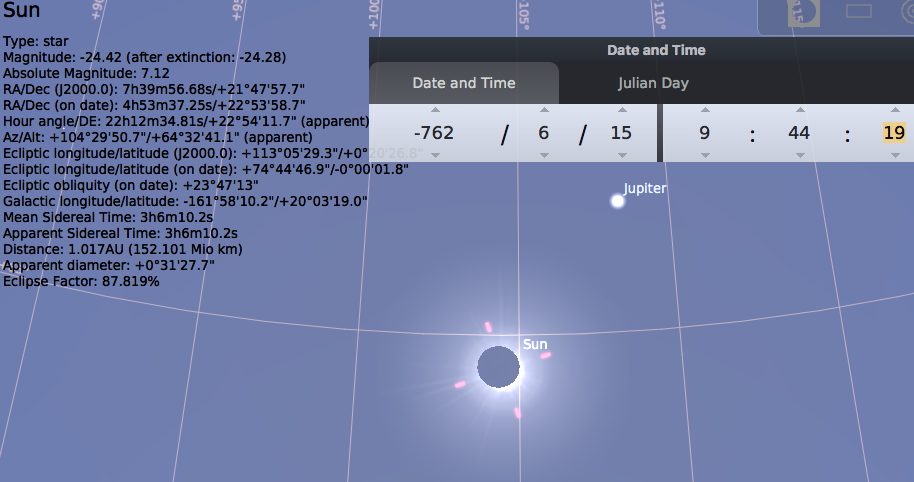
Figure 10: Predicted solar eclipse on 15 June 763 BC, observed in Samaria. Jupiter was visible during the eclipse around noontime.
A major earthquake with a magnitude of about 8.0 occurred in Israel in the eighth century BC. Many scholars have attempted to date the earthquake as accurately as possible [Israel Finkelstein, Bulletin of American Schools of Oriental Research, No. 314 (May 1999), pp. 55-70; and references therein]. Yadin in 1975 and Finkelstein in 1999 consistently dated the Hazor's earthquake at 760 BC$\pm 20$ years. Ibrahim and van der Kooij in 1977, 1978, 1991 and Vilders in 1992 dated the earthquake at 770 BC ± 25 years. Dever in 1992 dated Gezer's earthquake at 760 BC ± 25 years. Ussishkin in 1993 dated Lachish's earthquake at 760 BC±30 years. A simple average of the 4 data points above yields 762.5 BC±2.5 years, where ±2.5 years are the standard deviation of the average. The average date of 762.5 BC for the great earthquake is in perfect agreement with the date of the solar eclipse (15 June 763 BC). Similar to the solar eclipse in the spring of 1493 BC, which presaged the end of the First Dynasty of Babylon (Chapter 8), this solar eclipse presaged the end of Jeroboam's reign due to his great sin. This great earthquake should not have occurred naturally but arise from God's divine judgment.