Yeshua's Prophecies on His First Century Return
Matthew 10: 16-23 recorded the prophecy of Yeshua on the time of his return:
This prophecy of Yeshua suggests that his return should have taken place before his disciples had gone through all the cities of Israel. Yeshua also prophesied that his disciples would be persecuted and flee from one city to another. Before they went through all the cities of Israel or before the persecution was over, Yeshua should have returned. This is his first return he foretold his disciples. He also foretold his final return in Matthew 24:26-31.
If the prophecy of his first return would not have been fulfilled, Yeshua would not be the true Messiah and Savior. We will show that this prophecy was fulfilled in the spring of 67 AD when he returned to instruct John to measure the temple of God and to prophesy the destruction of Jerusalem in 42 months.
Just as the Spirit of God took Ezekiel from Babylon to Jerusalem (Ezekiel 8:3), the angel of God may have taken John from Patmos Island to the temple of God in Jerusalem. After John was given a reed-like measuring rod, the mighty angel stood and said to John, "Rise and measure the temple of God, the altar, and those who worship there. But leave out the court, which is outside the temple, and do not measure it, for it has been given to the Gentiles. And they will trample down the holy city, forty-two [42] months." (Revelation 11:1-2).
In most English translations, the preposition "for" has been added before 42 months. When "for" is added, the prophecy would read: "And they (the Gentiles) will trample down the holy city for 42 months." Since the holy city Jerusalem has never been trampled down continuously for 42 months, most Biblical scholars believe that this prophetic event shall take place in the end times after the third temple of God is rebuilt.
Since there is no "for" in the original text of Revelation 11:2 and the verb is in the future indicative active mode [describing a future action (snapshot) at a particular time], we can interpret this verse alternatively. If we add "in" before 42 months, the prophecy will read: "And they (the Gentiles) will trample down (destroy ruthlessly) the holy city in 42 months." This interpretation can be justified by analogy with John 2:20. The interlinear English translation of this verse is:
Here, the verb "οἰκοδομέω (oikodomeó)" means "erect a building" and "build a house." The verb "οἰκοδομήθη" in the above sentence is in the aorist indicative passive form. The Greek aorist tense in the indicative mood simply describes a past action (snapshot at a particular time). Therefore, the erection of the temple (the commencement of the temple's construction) is a past action relative to the time when the Jews spoke to Yeshua.
We have shown that the temple was erected (started to be built) in the spring of 20 BC, which was 46 years before the Jews spoke to Yeshua (see Chapter 12). Since these Jews knew that the construction of the temple started 46 years ago [and was still under way], their statement can be rephrased as: "The temple has been under construction for 46 years and you will raise it up in three days?"
In the Greek text of John 2:20, there is no preposition before 46 years nor adverb after 46 years. Adding the adverb "ago" after 46 years correctly conveys the meaning of this verse: The temple was erected 46 years before the Jews spoke to Yeshua. By analogy, adding the proposition "in" before 42 months in Revelation 11:2 conveys the idea that Jerusalem will be destroyed ruthlessly 42 months after this prophecy of the mighty angel. If this interpretation is correct, the book of Revelation was written 42 months before Jerusalem was destroyed.
Who is the mighty angel of God described in Revelation 10:1-3? The face of the mighty angel was like sun and his feet like pillars of fire (10:1), and a rainbow was on his head. He had a little book open in his hand and cried out with a loud voice like roaring of a lion (Revelation 10:3). In Matthew 17:2, we see that when Yeshua was transfigured into his glorious body, his face did shine as the sun. In Revelation 5:5, the slain Lamb was declared to be the lion of the tribe of Judah. From these descriptions, the mighty angel is likely to be Yeshua himself.
How is it possible that Yeshua is the angel of God? Yehowah God told Moses (NKJV with no modification): "Behold, I send an Angel before you to keep you in the way and to bring you into the place which I have prepared. Beware of Him and obey His voice; do not provoke Him, for He will not pardon your transgressions; for My name is in Him. For My Angel will go before you and bring you in to the Amorites and the Hittites and the Perizzites and the Canaanites and the Hivites and the Jebusites; and I will cut them off. ..." (Exodus 23:20-23). These verses tell us that because the Angel bears the name of Yehowah God, He is the regent of God, who acts and speaks on behalf of Yehowah God Himself. That is why the Angel of Yehowah and Yehowah Himself are inter-exchangeable in the five books of Moses. For example, "And the Angel of God, who went before the camp of Israel, moved and went behind them; and the pillar of cloud went from before them and stood behind them. So it came between the camp of the Egyptians and the camp of Israel. Thus it was a cloud and darkness to the one, and it gave light by night to the other, so that the one did not come near the other all that night." (Exodus 14:19-20). These verses tell us that the Angel of God went before the Israelites by day in a pillar of cloud to lead the way, and by night in a pillar of fire to give them light. This contrasts with Exodus 13:21 where Moses tells us that Yehowah Himself did the same things for the Israelites.
Who does bear the name of Yehowah? Moses called Hoshea (meaning salvation), the son of Nun, Yehoshua (Numbers 13:16). The name of Yehoshua is the compound name of Yehowah and Hoshea, which means "Yehowah is salvation." Yehoshua the son of Nun was a man and a leader of the Israelites. Yehoshua cannot be the Angel of God because he did not go before the Israelites by day in a pillar of cloud to lead the way, and by night in a pillar of fire to give them light. The name of Yeshua is the same as Yehoshua. Yeshua the son of Jozadak (Ezra 3:2) should not have been the Angel of God. The name of the Messiah is called Yeshua because he will save his people from their sins (Matthew 1:21). Since the name of the Messiah bears the name of Yehowah, he should be the Angel of God mentioned in the books of Moses. If this is true, no one in the Hebrew Bible (Tanakh) directly saw Yehowah God Himself, but His Angel who bears His Name. That is why Yeshua said, "No one has seen God at any time. The only begotten Son, who is in the bosom of the Father, he has declared Him." (John 1:18). Yeshua also said, "All the things have been delivered to me by my Father, and no one knows the Son except the Father, nor does anyone know the Father except the Son, and the one to whom the Son wills to reveal Him." (Matthew 11:27). Therefore, Yeshua's own words confirm that the Angel of God in the Old Testament is actually the Son of God who bears the Name (Yehowah) of his Father. The Son of God speaks and acts in the Name of his Father.
Because the messenger of God fully represents God, he speaks and acts with the same authority as God. In ancient China, the messenger of an emperor also speaks and acts with the same authority as the emperor. Whoever knows the identity of the messenger, he/she must bow down to him because he is like the emperor.
The capitalization of the words such as "Angel", "He", "His", and "Him" in these verses implies that the NKJV translators have referred to the Angel (Messenger) of God as the Son of God. Therefore, the author of the present book is not the only one who identifies the Angel of God in the Hebrew Bible as the only begotten Son of God.
One can clearly identify the Angel of God as Yeshua Messiah from Revelation 22:6-7. In Revelation 22:6-7, the angel said to John: "These words are faithful and true. And the Lord God of the holy prophets sent the angel of Him to show His servants the things which must shortly take place. Behold, I am coming quickly! Blessed is he who keeps the words of the prophecy of this book." From verse 22:6, we see that God sent the angel of Him to show His servants—things which must shortly take place. The angel also said to John (verse 22:7), "Behold, I am coming quickly..." In this verse, "I" must refer to the angel who talked to John and was one of the seven angels who had the seven bowls (Revelation 21:9). Who is coming quickly? It is the angel of God who is coming quickly. It is Yeshua Messiah who is coming quickly. In fact, the words recorded in Revelation 22: 9-16 are all from the angel of God. From the contents of these words, it is apparent that the angel must be Yeshua Messiah.
Therefore, the mighty angel in the book of Revelation is Yeshua himself. This conclusion is further supported by the verse: "And I will give power to my two witnesses, and they will prophesy one thousand two hundred and sixty days, clothed in sackcloth." (Revelation 11:3). Since the mighty angel gives power to his two witnesses who are the two olive trees and the two lampstands before the God of the earth, he must have great power and authority. No other angel in the Hebrew Bible has authority and power comparable to the Angel of Yehowah who bears His Name and executes all authority of Him. Yeshua the Son of God was given all authority in heaven and earth after he resurrected (Matthew 28:18) and was restored to his original glory before the world was created (John 17:5). Yeshua also declared that all the things the Father has are his (John 16:15). The Son of God has authority to send the Holy Spirit (the Spirit of the Truth) from the Father to his disciples to testify of him (John 15:26) and to guide his disciples into all truth (John 16:13). Therefore, only the Son of God has such a great authority to give power to his two witnesses.
Who are the two witnesses of the mighty angel? When Yeshua was transfigured into his glorious body, Moses and Elijah also appeared to three disciples of Yeshua (Matthew 17:3). This implies that Moses and Elijah are the two witnesses of Yeshua. The two witnesses in the book of Revelation should also be Moses and Elijah because they will perform miracles (Revelation 11:5-6) similar to those performed by Moses and Elijah in the past and because Yeshua stated that Elijah would come in a future time (Matthew 11:14). The future time for Elijah to come should be right before the great day of Yehowah in the end times, which was prophesized in Malachi 4:5, "Behold, I will send you Elijah the prophet before the coming of the great and dreadful day of Yehowah." The great and dreadful day of Yehowah (probably the third woe) will take place after the 7th trumpet and the second woe (see Chapter 40). The two witnesses sent by the mighty angel of God will prophesize 1260 days before the 7th trumpet sounds (Revelation 11). One of the witnesses, Elijah, will be sent by Yehowah Himself according to Malachi 4:5. The apparent contradiction between Malachi and Revelation can be naturally resolved if the mighty angel of God is Yeshua himself who received all the power and glory from his Father after his resurrection. Yeshua has the authority to send the Spirit of Truth from his Father to his disciples after he sat on the right-hand side of his Father. Therefore, the mighty angel of God must be Yeshua himself in order for Moses and Elijah to be his witnesses.
When was John on Patmos Island? The time must have been in the period when the disciples of Yeshua were persecuted (Revelation 1:9). We know that Nero severely persecuted the Christians and the Jews between 64 and 68 AD. But most Biblical scholars believe that John was on Patmos Island around 90 AD when Domitian was the Roman emperor (81-96 AD). There is no historical record of severe persecution of Christians during the reign of Domitian.
We will use the historical records of Josephus about the Jewish war to determine the time of John's writing of the book of Revelation. Josephus told us (Wars, bk. 6, ch. 5, sect. 3):
This passage tells us that before the Jewish war started (in April of 67 AD), there were two astronomical phenomena: A star resembling a sword stood over the city and a comet appeared. The Chinese astronomers also recorded these two astronomical phenomena separated by about 7 months. The separation between the revolt of the Jews (in the fall of 66 AD) and the starting of the Jewish war (in April of 67 AD) was also about 7 months. So, what Josephus tells us is that the two astronomical phenomena took place about one year before the revolt of the Jews and before the starting of the Jewish war, respectively. Since the original Greek text does not have punctuation, the English translation may read as: "Thus there were a star resembling a sword (which stood over the city) and a comet, which were a whole year before the Jews' revolt and before those commotions (which preceded the war), respectively."
The Chinese recorded a comet-like star on 29 July 65 AD: "孝明永平八年六月壬午,长星出柳张, 三十七度,犯轩辕,刺天船,陵太微,气至上阶,凡见五十六日去." Our English translation reads:
Figure 12 simulates the above description of the long star. The Chinese word "刺" (which means "stab") suggests that the long star was like a sword. The "sword" stabs towards Perseus.
Since the revolt of the Jews took place in the fall of 66 AD and the long star was seen in August and September of 65 AD, the separation of the two events was indeed about one year, in agreement with the account of Josephus.
The Chinese astronomer also recorded a comet on 20 February 66 AD: "On the day of wu-shen (the 45th day of a sexagenary cycle) in the first month, in the ninth year of the Yong-Ping reign-period of King Xiao-Ming, a "guest star" (comet) appeared in α-Altair (ninth lunar mansion) with a length of 8 feet. It went out of sight after appearing for 50 days."
This comet appeared in February, March, and in early April of 66 AD, which was also about one year before the commotions which preceded the Jewish war (in April of 67 AD).
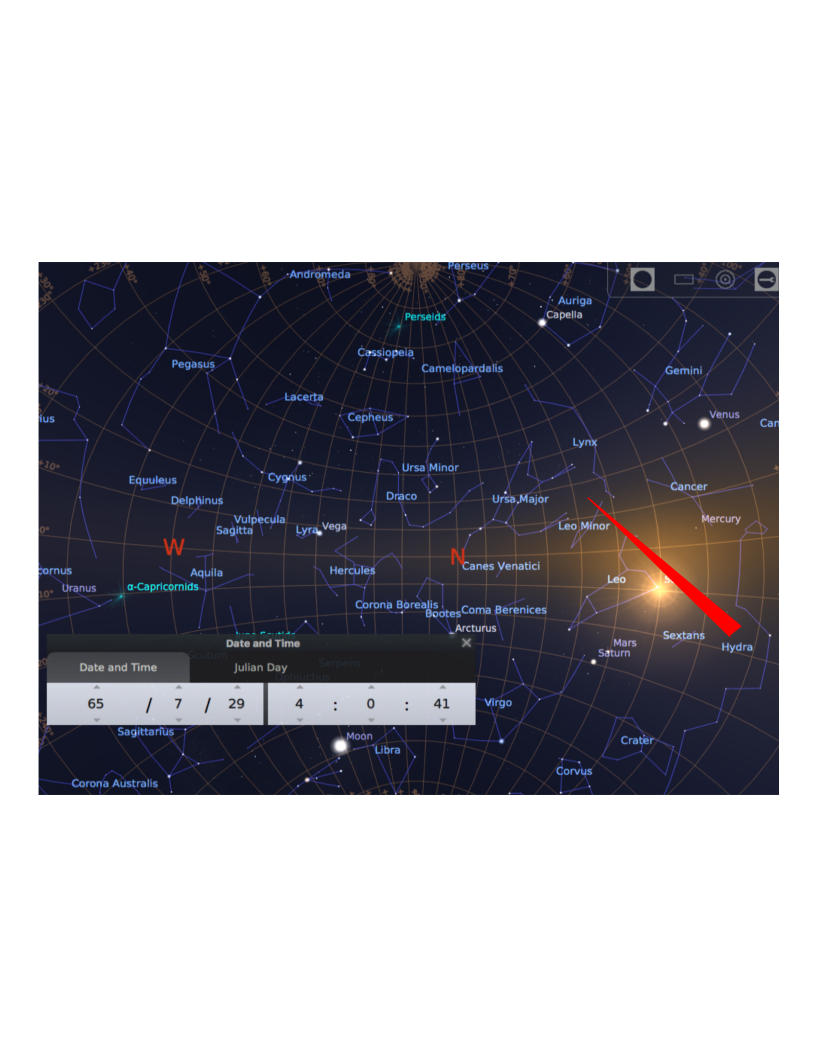
Figure 12: A comet-like long-star was like a sword (indicted by an arrow), which appeared on 29 July 65 AD and was recorded by the Chinese astronomer. The "sword" stabs (points) towards Perseus.
Josephus tells us that on the eighth day of the month Xanthicus [the first Macedonian month] of 67 AD, the Jews came in great crowds for the feast of unleavened bread. At the ninth hour of the night (about 3:00 am) in the 9th day, a great light shone around the altar and the temple for half an hour, and it appeared like the daytime due to the great light.
This miraculous event recorded by Josephus may be related to the event described in Revelation 11:2. This verse tells us that the mighty angel and John were inside the holy temple of God and the angel instructed John to measure the temple of God, the altar, and those who worshipped there. Since the face of the angel was like the sun, the altar and the holy temple must have been brightened like the daytime at his presence. Those who worshipped there must have seen the great light. Josephus should have eye witnessed it or obtained the information from those who worshipped there. The mighty angel must have chosen this particular time to let his people witness the miraculous event as a warning sign.
The 9th day of the month Xanthicus of 67 AD happened to be the 9th day of the month Nisan in the Hebrew calendar (see Appendix D), which was on April 12 and on Sunday. Yeshua also revealed to John on Sunday according to Revelation 1:10-11 (Hebraic-Roots Version):
It is interesting to note that the Hebrew version of Revelation does not identify the first day of the week as the Lord's Day. In the Greek version, the first day of the week was changed into the Lord's Day. Since the original book of Revelation was written in Hebrew (see the proof in the beginning part of The Hebraic-Roots Version Scripture), the change of the Lord's Day to the first day of the week did not originate from God.
If Yeshua prophesied the destruction of Jerusalem in the holy temple on 12 April 67 AD (the 9th day of the month Xanthicus or Nisan), exactly 42 lunar months after the prophecy should have been on the 8^th^ day of the month Gorpeius [the sixth month] (September 3) of 70 AD or on the 9th day of the month Elul in the Hebrew calendar (the Macedonian calendar in 70 AD was one day later than the Hebrew calendar). This date can be easily figured out considering the fact that there was one embolismic year from 67 to 70 AD. From 12 April 67 AD to 3 September 70 AD, there were 1240 days = 42×29.524 days = 42 lunar months
According to the prophecy of the mighty angel, Jerusalem should have been destroyed by the Gentles 42 months from the time of his prophecy. If this prophecy was fulfilled perfectly, Jerusalem should have been destroyed on the eighth day of the month Gorpeius of 70 AD. This is indeed the case. According to Josephus (Wars, bk. 6, ch. 10, sect. 1), "And thus was Jerusalem taken, in the second year of the reign of Vespasian [70 AD], on the eighth day of the month Gorpeius. It had been taken five times before though this was the second time of its desolation."
The perfect fulfillment of this prophecy also pins down the exact time of John's writing of the revelation of Yeshua and the exact time of Yeshua's first return. Therefore, we are certain that on 12 April 67 AD (Sunday) John wrote the book of Revelation, and Yeshua (the mighty angel) returned to the earth, revealing himself only to John. Yeshua's first return on 12 April 67 AD perfectly fulfills the prophecy of Yeshua in Matthew 10:23: His return should have taken place before his disciples went through all the cities of Israel and before the end of the severe persecution of his disciples in 68 AD. Yeshua's first return on Nisan 9 of 67 AD was to prophesize and to warn the pending judgment of God on His people. It is the Messiah who destroyed Jerusalem and the temple with the Gentile's prince, as prophesized in Daniel 9:26-27 (see Chapter 17).
His return in 67 AD also fulfilled a puzzling prophecy of Yeshua, which was recorded in the Gospel of John (John 21:21-23): "Peter, seeing him, said to Yeshua, 'But Lord, what about this man?' Yeshua said to him, 'If I will that he remains till I come, what is that to you? You follow me.' Then this saying went out among the brethren that this disciple would not die. Yet Yeshua did not say to him that he would not die, but, 'If I will that he remains till I come, what is that to you?'" Indeed, John was still alive in 67 AD at Yeshua's first return but Peter had died before 67 AD.
His return in 67 AD fulfilled one more puzzling prophecy of Yeshua, which was recorded in Matthew 16:28, "Assuredly, I say to you, there are some standing here who shall not taste death till they see the Son of Man coming in his kingdom (royal power)." Here, Greek word "βασιλεία" means "kingdom," "sovereignty," and "royal power." The best English translation of "βασιλεία" in this verse should be "royal power," because this verse is in parallel with Matthew 16:27, "For the Son of Man will come in the glory of his Father with his angels, and then he will reward each according to his works." Verse 27 talks about his final return in the glory of his Father to judge the whole world while verse 28 refers to his return in 67 AD in his royal power. In 67 AD, John, Jude, and Simon were still alive while all the other disciples of Yeshua were martyred (please see the martyrdom of the 12 disciples of Yeshua at http://www.about-jesus.org/martyrs.htm). This fact clearly confirms Yeshua's prophecy that he would come in royal power at the time when some of his disciples were still alive.
The perfect fulfillment of this numerical prophecy proves that the Gospels of Matthew and John and the book of Revelation are the inspired Word of God. This also provides clear evidence for Yeshua being the true prophet of God, as foretold by Moses in Deuteronomy 18:17-22.