Chinese Chronology
China is one of the world's most ancient civilizations. China's written history was generally believed to begin from the Shang Dynasty over 3,000 years ago. Ancient historical texts such as the Records of the Grand Historian (about 100 BC) and the Bamboo Annals (the 6th century BC) describe the earlier dynasties (e.g., the Xia Dynasty) before the Shang Dynasty. The Shujing (Shu-king), the Chinese historical classic document, compiled by Confucius (551-479 BC) provides a record of religion, philosophy, customs, and government of the Chinese from the earliest times. The authenticity of these records remains an open question because the earliest recorded historical events had already taken place about 2,000 years before the authors compiled them.
The Chinese chronology after 770 BC (after the Eastern Zhou Dynasty) has been accurately established with no uncertainty. This accuracy is warranted by the fact that the chronology is in perfect agreement with all recorded astronomical data. In contrast, the Chinese chronology prior to 770 BC has not been resolved despite tremendous efforts of Chinese scholars from several different fields since 1996. The Xia-Shang-Zhou Chronology Project (Chinese: 夏商周断代工程, Pinyin: Xiɑ-Shɑnɡ-Zhou Duɑndɑi Gonɡcheng) was a multi-disciplinary project commissioned by the government of China in 1996. The objective of this project was to accurately determine the locations and timelines of the Xia, Shang, and Zhou Dynasties. To achieve better accuracy of the chronology, some 200 experts took part in the project which involved multiple methods such as the radiocarbon dating method, archaeological dating method, historical textual analysis, astronomy, and so on. Preliminary results of the project were released in November of 2000. However, the conclusions have been disputed by many scholars.
The main conclusion of the project is that the first year of King Yi (懿王)of the Western Zhou Dynasty is fixed in 899 BC, which shifts forward the previously assigned year of 935 BC by 36 years. This conclusion is based on an interpretation of a solar eclipse that was seen in the first year of King Yi. This interpretation was published in 1995 by scholars from the Jet Propulsion Laboratory (JPL) and University of California at Los Angeles (UCLA). In this publication, an earlier morning solar eclipse on 21 April 899 BC was attributed to the solar eclipse observed in the first year of King Yi. In the following paragraphs, we will show that because of this incorrect interpretation, the Chinese chronology before the Eastern Zhou Dynasty shifts forward by many years and becomes less accurate than the traditional Chinese chronology established before 1996.
In Table VI below, we have reconstructed the Chinese chronology starting from the first year of Huang-Di (Yellow Emperor) based on all the available astronomical data recorded mostly in the Bamboo Annals. The regnal lengths of the kings marked by "Common Scheme" in the last column of Table VI are taken from a historical book "中国历史年表, Timelines of Chinese History", which was compiled by 柏杨 (Bo Yang), a famous author in Taiwan, China. The book was published in 1977, well before the Xia-Shang-Zhou Chronology Project. The regnal lengths of the kings between Emperor Yao and the Eastern Zhou Dynasty are nearly identical to those listed by James Legge, which were obtained from Common Scheme. The regnal lengths marked by "Bamboo Annals" are directly taken from the Bamboo Annals, where the regnal lengths perfectly match the astronomical data, particularly in the period between Wu-Ding and Di-Xin. The total number of years between Wu-Ding and Di-Xin determined from Common Scheme is only one year shorter than that inferred from the Bamboo Annals.
Detailed accounts of kings that were recorded in the Bamboo Annals are usually reliable. In contrast, short and brief records of kings in the Bamboo Annals are not so reliable, possibly because the original detailed records were lost and modified or reconstructed by latter historians. What is amazing is that the astronomical records of some "crucial" kings in the Bamboo Annals remain intact, which allow us to precisely determine the beginning and the ending of each kingdom in the early dynasties. In particular, the detailed records of Huang-Di, Yao, Shun, Yu, Zhong-Kang, Gui (Jie), Wu-Ding, Di-Xin, Zhou Cheng-Wang, Zhou You-Wang, and Zhou Ping-Wang can perfectly recover the entire chronology of the Chinese history without noticeable errors due to the concurrently recorded astronomical phenomena. The recorded astronomical phenomena allow us to accurately trace backward the times of the ancient Chinese kings. Below, we will provide some examples to demonstrate how we use the astronomical phenomena to accurately determine the ascension years of Huang-Di, Yao, Shun, Yu, and some other important kings/emperors.
In order to fully understand the section of "detailed explanations" below, one needs to have a strong background in science as well as Chinese history and culture. If readers wish to verify the authenticity of the chronology and are interested in Chinese history and culture, they may continue to read this chapter carefully. Otherwise, they could skip the section of "detailed explanations" below.
The first (ascension) year of Emperor Yao has been verified by 4 independent astronomical phenomena. These astronomical phenomena consistently show that Yao started his reign in the fall of 2376 BC. In Yao's 61st year, which was in 2315 BC, China's "great flood" took place. It is amazing that China's great flood happened in the same year as Noah's flood (see Chapter 10). The accurate timeline of Emperor Yao proves the accuracy of our current Biblical chronology which will be shown in Chapter 10.
Yao's timeline also resolves a 2,000-year controversy as to whether Noah's flood was regional or global. His timeline clearly tells us that God did not destroy all the Chinese people by the flood, and that the Chinese people are not the descendants of Noah. This conclusion is in sharp contrast to a general belief of most Christians: Noah's flood was global and destroyed all humans except for the 8 people in Noah's family. This general belief appears to be supported by the Biblical account of Noah's flood. Nevertheless, with a correct understanding of the Hebrew word "כֹּל kol" (meaning all) in the Hebrew Bible, one can also conclude that Noah's flood should have been regional (for detailed argument of Dr. Michael Heiser for local regional flood from the Biblical text, please see https://drmsh.com/argue-biblical-text-local-regional-flood-instead-global-flood/).
About 2,000 years ago, Flavius Josephus, Jewish priest and historian, agreed with his contemporary historians and wrote: "There is a great mountain in Armenia, over Minyas, called Baris, upon which it is reported that many who fled at the time of the Deluge were saved; and that one who was carried in an ark came on shore upon the top of it; and that the remains of the timber were a great while preserved. This might be the man about whom Moses, the legislator of the Jews, wrote." (Antiq. bk. 1, ch.3, sect. 6). The implication of Josephus' writing is that many people apart from Noah's family survived Noah's flood, in agreement with China's historical records.
Since Josephus was a Pharisee and a Jewish priest, he must have understood the Hebrew Scriptures very well. He would not have written the above paragraph concerning the survivors of Noah's flood if his own understanding of the Hebrew Scriptures had convinced him that only Noah's family would have survived from the flood. Therefore, Josephus must have had the same understanding of the Hebrew Scriptures as Dr. Michael Heiser who argued for local regional flood from the Biblical text.
| Rulers **Regnal | Regnal time **Regnal | Regnal length (year) **Comment | Comment |
|---|---|---|---|
| Huang Di黄帝 2716-2616 B | 16-2616 BC 100 | 0 Huang Di St | ang Di Started to reign in the autumn of 2716 BC; Solar eclipse on 21 September 2666 BC in year 50 |
| Shao Hao少昊 2616-2533 B | 16-2533 BC 83 | *Common Sch | ommon Scheme* |
| Xuan Di玄帝 2533-2455 B | 33-2455 BC 78 | *Common Sch | ommon Scheme* |
| Di Ku帝喾 2455-2385 B | 55-2385 BC 70 | *Common Sch | ommon Scheme* |
| Di Zhi帝挚 2385-2376 B | 85-2376 BC 9 | *Common Sch | ommon Scheme* |
| Yao 尧 2376-2276 | 376-2276 BC 100 | 00 Yao starte | ao started to reign between 29 August and 17 November 2376 BC. Venus was seen in Yi on 28 August 2334 BC in year 42; solar eclipse on 18 November 2324 BC in year 53; Venus was seen in Yi on 25 June 2306 BC in year 70; five stars (like threaded pearls) were seen on 8 April 2306 BC in year 70. |
| No king 2276-2271 | 2276-2271 BC 5 | 5 See main | See main text. |
| Shun 舜 2271-2221 | 271-2221 BC 50 | 0 Venus was | enus was seen in Fang (Scorpius) between 8-19 September 2271 BC right upon his ascension. |
| Yu 禹 2257-2221 | 257-2221 BC 36 | 6 Co-reigned | o-reigned with Shun; heavenly word that Shun should resign in favor of Yu in 2257 BC, in the end of year 14. |
| No king 2221-2218 | 2221-2218 BC 3 | 3 *Common S | Common Scheme |
| Yu 禹 2218-2210 | 218-2210 BC 8 | *Bamboo An | Bamboo Annals:* Yu reigned for 45 years, reigned solely for 8 years. |
| Qi 啟 2210-2200 | 210-2200 BC 10 | 0 *Common Sc | Common Scheme* |
| Tai Kang 太康 2200-2171 B | 00-2171 BC 29 | *Common Sch | ommon Scheme* |
| Zhong Kang 仲康 2171-2158 B | 71-2158 BC 13 | Solar eclip | lar eclipse on 22 November 2167 BC in the 9th month of year 5 |
| Xiang 相 2158-2131 | 158-2131 BC 27 | 7 *Common Sc | Common Scheme* |
| Usurpation 2131-2091 | 2131-2091 BC 40 | 40 *Common S | Common Scheme |
| Shao Kang 少康 2091-2069 B | 91-2069 BC 22 | *Common Sch | ommon Scheme* |
| Zhu 杼 2069-2052 | 069-2052 BC 17 | 7 *Common Sc | Common Scheme* |
| Huai 槐 2052-2026 | 052-2026 BC 26 | 6 *Common Sc | Common Scheme* |
| Mang 芒 2026-2008 | 026-2008 BC 18 | 8 *Common Sc | Common Scheme* |
| Xie 泄 2008-1992 | 008-1992 BC 16 | 6 *Common Sc | Common Scheme* |
| Bu Jiang 不降 1992-1933 B | 92-1933 BC 59 | *Common Sch | ommon Scheme* |
| Jiong 扃 1933-1915 | 933-1915 BC 18 | 8 *Bamboo An | Bamboo Annals* |
| Jin 廑 1915-1894 | 915-1894 BC 21 | 1 *Common Sc | Common Scheme* |
| Kong Jia 孔甲 1894-1863 B | 94-1863 BC 31 | *Common Sch | ommon Scheme* |
| Gao 皋 1863-1852 | 863-1852 BC 11 | 1 *Common Sc | Common Scheme* |
| Fa 發 1852-1833 | 852-1833 BC 19 | 9 *Common Sc | Common Scheme* |
| Gui 癸 1833-1781 | 833-1781 BC 52 | 2 Solar ecli | olar eclipse on 15 June 1805 BC in year 29 |
| Tang 汤 1781-1768 | 781-1768 BC 13 | 3 Shang Dyna | hang Dynasty started. |
| Tai-Jia 太甲 1768-1735 B | 68-1735 BC 33 | *Common Sch | ommon Scheme* |
| Wo-Ding 沃丁 1735-1706 B | 35-1706 BC 29 | *Common Sch | ommon Scheme* |
| Tai-Kang 太康 1706-1681 B | 06-1681 BC 25 | *Common Sch | ommon Scheme* |
| Xiao-Jia 小甲 1681-1664 B | 81-1664 BC 17 | *Common Sch | ommon Scheme* |
| Yong-Ji 雍己 1664-1652 B | 64-1652 BC 12 | *Common Sch | ommon Scheme* |
| Tai-Wu 太戊 1652-1577 B | 52-1577 BC 75 | *Common Sch | ommon Scheme* |
| Zhong-Ding 仲丁 1577-1564 B | 77-1564 BC 13 | *Common Sch | ommon Scheme* |
| Wai-Ren 外壬 1564-1549 B | 64-1549 BC 15 | *Common Sch | ommon Scheme* |
| He-Dan-Jia 河亶甲 1549-1540 BC | 9-1540 BC 9 | *Common Sche | mmon Scheme* |
| Zu-Yi 祖乙 1540-1521 B | 40-1521 BC 19 | *Common Sch | ommon Scheme* |
| Zu-Xin 祖辛 1521-1505 B | 21-1505 BC 16 | *Common Sch | ommon Scheme* |
| Wo-Jia 沃甲 1505-1480 B | 05-1480 BC 25 | *Common Sch | ommon Scheme* |
| Zu-Ding 祖丁 1480-1448 B | 80-1448 BC 32 | *Common Sch | ommon Scheme* |
| Nan-Geng 南庚 1448-1423 B | 48-1423 BC 25 | *Common Sch | ommon Scheme* |
| Yang-Jia 阳甲 1423-1416 B | 23-1416 BC 7 | *Common Sch | ommon Scheme* |
| Pan-Geng 盤庚 1416-1388 B | 16-1388 BC 28 | *Common Sch | ommon Scheme* |
| Xiao-Xin 小辛 1388-1367 B | 88-1367 BC 21 | *Common Sch | ommon Scheme* |
| Xiao-Yi 小乙 1367-1339 B | 67-1339 BC 28 | *Common Sch | ommon Scheme* |
| Wu-Ding 武丁 1339-1280 B | 39-1280 BC 59 | Total lunar | tal lunar eclipse on 24 November 1311 BC in the 12th month of year 29 |
| Zu-Geng 祖庚 1280-1269 B | 80-1269 BC 11 | *Bamboo Ann | amboo Annals* |
| Zu-Jia 祖甲 1269-1236 B | 69-1236 BC 33 | *Bamboo Ann | amboo Annals* |
| Lin-Xin 廩辛 1236-1232 B | 36-1232 BC 4 | *Bamboo Ann | amboo Annals* |
| Geng-Ding 庚丁 1232-1224 B | 32-1224 BC 8 | *Bamboo Ann | amboo Annals* |
| Wu-Yi 武乙 1224-1189 B | 24-1189 BC 35 | *Bamboo Ann | amboo Annals* |
| Tai-Ding 太丁 1189-1176 B | 89-1176 BC 13 | Zhou Wen-Wa | ou Wen-Wang started to reign in 1178 BC in the 12th year of Tai-Ding. |
| Di-Yi 帝乙 1176-1168 B | 76-1168 BC 8 | *Bamboo Ann | amboo Annals*: Di-Yi died in his 9th year. He should die just after new year and Di-Xin started his first year in the beginning of the 9th year of Di-Yi. |
| Di-Xin 帝辛 1168-1116 B | 68-1116 BC 52 | Solar eclip | lar eclipse on 10 September 1121 BC in year 48; Solar eclipse on 10 September 1117 BC in year 52; five stars were seen in constellation of Fang on 29 December 1137 BC in year 32. Zhou Wen-Wang died in 1128 BC in the spring of year 41 (total regnal length is 50 years). Di-Xin was executed on 27 January 1116 BC, which was in the second month, in the day of jia-zi (1st day of cycle). |
| King Wu 武王 1127-1116 B | 27-1116 BC 11 | Wu started | started to reign in year 42 of Di-Xin. |
| King Wu 武王 1116-1110 B | 16-1110 BC 6 | Zhou Dynast | ou Dynasty started. |
| King Cheng 成王 1110-1073 B | 10-1073 BC 37 | Solar eclip | lar eclipse on 7 March 1093 BC in the first month of spring of year 18; Common Scheme |
| King Kang 康王 1073-1047 B | 73-1047 BC 26 | *Common Sch | ommon Scheme* |
| King Zhao 昭王 1047-996 BC | 47-996 BC 51 | *Common Sch | ommon Scheme* |
| King Mu 穆王 996-941 BC | 6-941 BC 55 | *Common Sch | ommon Scheme* |
| King Gong 共王 941-926 BC | 1-926 BC 15 | https://zh. | tps://zh.wikipedia.org/wiki/周共王 |
| King Yi 懿王 926-901 BC | 6-901 BC 25 | Solar eclip | lar eclipse on 21 March 926 BC in the first month of year 1; Common Scheme |
| King Xiao孝王 901-886 BC | 1-886 BC 15 | *Common Sch | ommon Scheme* |
| King Yi夷王 886-878 BC | 6-878 BC 8 | *Bamboo Ann | amboo Annals* |
| King Li 厲王 878-841 BC | 8-841 BC 37 | *Common Sch | ommon Scheme* |
| Gong He 共和 841-827 BC | 1-827 BC 14 | *Common Sch | ommon Scheme* |
| King Xuan宣王 827-781 BC | 7-781 BC 46 | *Common Sch | ommon Scheme* |
| King You 幽王 781-770 BC | 1-770 BC 11 | Solar eclip | lar eclipse on 6 September 776 BC, in the day of xin-mao (28th of the cycle) in year 6; Common Scheme |
| King Ping 平王 770-719 BC | 0-719 BC 51 | Solar eclip | lar eclipse on 22 February 720 BC in the second month of year 51; Common Scheme |
| King Nan 周赧王 314-256 BC | -256 BC 59 | Zhou ended | u ended |
| King Zhao 秦昭王 255-251 BC | -251 BC 4 | Qin began to | began to reign in the land of Zhou. |
| Qin Shi-Huang秦始皇 220-210 BC | -210 BC 10 | Qin United C | United China started. |
| Han Wang 汉王 206-202 BC | 6-202 BC 4 | Western Han | stern Han Dynasty started. |
| Han Gaozu 汉高祖 202-195 BC | -195 BC 7 | ||
| Han Ai Di汉哀帝(Jianping Era) 6-3 BC | BC | "Comet" seen | met" seen in the second month of the second year of Jian-ping (between March 8 and April 7 of 5 BC). |
| Guangwu Di 光武帝 August 25 AD | ust 25 AD-March 57 AD 31 | Eastern Han | tern Han Dynasty started. |
| Three Kingdoms 三国 220-280 AD | 0-280 AD 60 | ||
| Western Jin 西晋 266-316 AD | 6-316 AD 50 | ||
| Eastern Jin 东晋 317-420 AD | 7-420 AD 103 | 3 | |
| Sixteen Kingdoms 十六国 304-439 AD | -439 AD 135 | ||
| Northern and Southern Dynasties 南北朝 386-589 AD | -589 AD 203 | ||
| Sui dynasty 隋 581-618 AD | 81-618 AD 37 | 7 | |
| Tang dynasty 唐 618-907 AD | 18-907 AD 289 | 89 | |
| Five Dynasties and Ten Kingdoms 五代十国 907-960 AD | 960 AD 53 | ||
| Northern Song 北宋 960-1127 AD | 0-1127 AD 167 | 7 | |
| Southern Song 南宋 1127-1279 A | 27-1279 AD 152 | 2 | |
| Liao Dynasty 辽 907-1125 A | 07-1125 AD 218 | 18 | |
| Western Liao 西辽 1124-1218 A | 24-1218 AD 94 | ||
| Western Xia 西夏 1038-1227 A | 38-1227 AD 189 | 9 | |
| Jin Dynasty 金 1115-1234 | 115-1234 AD 119 | 19 | |
| Yuan Dynasty 元 1271-1368 | 271-1368 AD 97 | 7 | |
| Ming Dynasty 明 1368-1664 | 368-1664 AD 276 | 76 | |
| Qing Dynasty 清 1636-1912 | 636-1912 AD 276 | 76 | |
| Republic China 中华民国 1912-1949 AD | -1949 AD 37 | ||
| People's Republic of China 中华人民共和国 1949 AD-present | -present |
CH09-S02-TBL-01
Detailed explanations
In the following, we will demonstrate how we use the recorded astronomical phenomena to accurately determine the ascension years of King Yi, Zhou Cheng-Wang, Huang-Di, Yao, Shun, Yu, Zhong-Kang, and Zhou Wen-Wang. The obtained error-free ascension years of these kings are crucial to our reconstruction of the accurate Chinese chronology.
1. The first year of King Yi
As discussed above, two American scholars from JPL and UCLA published a paper in 1995 to show that the early morning solar eclipse on 21 April 899 BC occurred in the first year of King Yi. Scholars in mainland China simply accepted this conclusion without carefully examining all possible alternatives. This paper was based on the original Chinese text recorded in the Bamboo Annals, which reads: "元年丙寅,春正月,王即位,天再旦于郑." The first English translation of this text was given by James Legge: "In his first year, which was ping-yin (third day of cycle), when he came to the throne, there were two sunrises in Ching."
There are two problems with the interpretation in the 1995 paper. First, the original Chinese text clearly says that the solar eclipse took place in the first month of spring. The day of 21 April 899 BC could never have been in the first month of spring according to any Chinese lunisolar calendar. Second, if we use an accurate delta-T parameter (see Appendix A), we find that the maximum coverage (90.6%) of the solar eclipse occurred at 5:57, 16 minutes before sunrise at 6:13. There is nothing that could mimic two sunrises.
Since the meaning of "天再旦(Pinyin: tian zai dan)" is not unique, the Chinese text could also be translated as: "In his first year, which was bing-yin (the third day of a sexagenary cycle), in the first month of spring, when he came to the throne, the sky brightened twice in Zheng."
The basic meaning of "旦" is "sunrise," so "再旦" could mean "one more sunrise." But "旦" could also mean "brighten," so "天再旦" in the Chinese text could also mean that the sky brightens again. Therefore, "天再旦" could simply mimic the phenomenon of a solar eclipse.
A predicted solar eclipse on 21 March 926 BC should have corresponded to the first year of King Yi. The day of 21 March 926 BC was indeed in the last day of the first month of spring according to the Chinese lunisolar calendar (see Chapter 5). Therefore, the first year of King Yi should have been in 926 BC rather than in 899 BC.
2. The 18^th^ year of Zhou Cheng-Wang
Another solar eclipse is predicted to have taken place on 7 March 1093 BC, which matched the recorded solar eclipse in the Bamboo Annals: "十八年,春正月,王如洛邑定鼎,凤凰见,遂有事于河." Our English translation of this text is: "In the 18th year of Zhou Cheng-Wang (King Cheng), in the first month of spring, the king went to Luo (Luo-yang). Phoenixes appeared and sacrifices were offered at the river (Luo River)."
In order to understand why this description refers to a solar eclipse, we need to understand the Chinese culture first. The phoenix is a bird that signifies a union of yin (阴) and yang (阳). The Chinese word 阴 (yin) derives from the word 月(moon) and 阳(yang) from the word 日(sun). Thus, the meeting of both male and female phoenixes imitates how the Sun and the Moon come together, namely, the course of a solar eclipse. Then, the above text could be re-phrased as: "There was a solar eclipse and sacrifices were offered at the river." Since the people in ancient China considered solar eclipses to be ill omens, they attempted to offer sacrifices to please Heaven. Thus, whenever there is a statement: "Sacrifices were offered," there must have been a solar eclipse. Indeed, we find that the sacrifice events recorded in the Bamboo Annals were always associated with the occurrences of solar eclipses.
Remarkably, a solar eclipse is predicted to occur on 7 March 1093 BC. This eclipse should have occurred in the 18th year of King Cheng if the first year of King Yi was in 926 BC (see Table VI). The day of 7 March 1093 BC was on the last day of the first month of spring according to the Chinese lunisolar calendar, which also matches the historical record. Therefore, our consistent interpretations of the two solar eclipses recorded in the Bamboo Annals lead to the only conclusion that the first year of King Yi must have been in 926 BC rather than in 899 BC.
3. The first year of Huang-Di
According to the historical book of Bo Yang, the total number of years between the first year of Huang-Di and the first year of Emperor Yao is 340. It is amazing that the astronomical records in the Bamboo Annals are in perfect agreement with this number.
The Bamboo Annals recorded for Huang-Di: "五十年秋七月庚申,凤鸟至,帝祭于洛水." The English translation reads: "In his (Huang-Di's) 50th year, in the autumn, in the 7th month, on day geng-shen (the 57th day of a sexagenary cycle), phoenixes arrived, and the emperor offered sacrifices at Luo River."
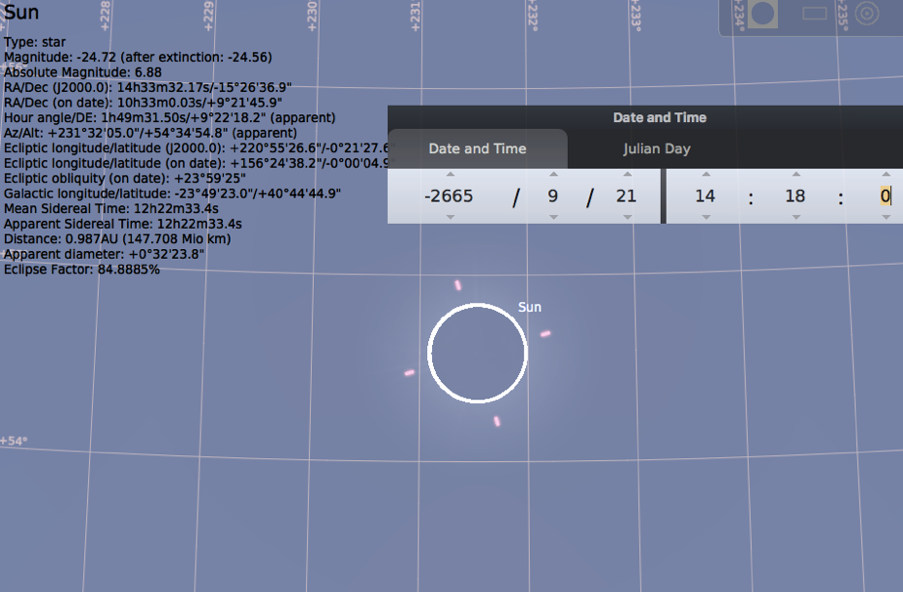
Figure 4: Predicted solar eclipse on 21 September 2666 BC, observed in Xin-Zheng city.
As mentioned above, whenever there is a statement: "Phoenixes arrived (or appeared) and the emperor offered sacrifices..." in the Bamboo Annals, it must refer to a solar eclipse. We searched solar eclipses between 2600-2700 BC using the Stellarium Program and found a solar eclipse in China on 21 September 2666 BC. The day of 21 September 2666 BC was indeed at the end of the 7th month according to the Xia calendar (see below), perfectly matching the record of the Bamboo Annals. If this solar eclipse was indeed the one observed in the 50th year of Huang-Di, the first (ascension) year of his reign should have been after the 8th month of 2716 BC, which corresponded to the 7th month (Tishri) in the Hebrew calendar.
The eclipse was seen in Xin-Zheng city (34o23'40''N113o44'20"E) on day gui-wei (癸未) (the 20th day of a sexagenary cycle) according to the counting method of the Shang Dynasty.
With a delta-T parameter: ΔT = –20 + 33.0t2, the middle eclipse was at 14:18 with the eclipse factor of 84.89% (see Figure 4).
Since the new moon was at 21:06 on August 22, the first day of the 7th month started from the evening of August 22, and September 21 was in the 30th day of the 7th month. Thus, the month of the solar eclipse exactly matches the historical record. But the day gui-wei calculated from the counting method of the Shang Dynasty does not match the recorded one (geng-shen). This is understandable since the chroniclers in the Shang Dynasty may have reset the first day of a sexagenary cycle.
4. The first year of Emperor Yao
If we believe that there were 340 years between the first year of Huang-Di and that of Emperor Yao, Yao should have started his reign in the autumn of 2376 BC. This is confirmed by several independent astronomical phenomena recorded in the Bamboo Annals. For example, the Bamboo Annals recorded: "五十三年,帝祭于洛." The English translation is: "In his (Yao's) 53rd year, the emperor offered sacrifices at Luo River."
Whenever there is a statement: "The emperor offered sacrifices ..." in the Bamboo Annals, it must refer to a solar eclipse. This means that there should have been a solar eclipse in his 53rd year (from the autumn of 2324 BC to the autumn of 2323 BC). There was indeed a solar eclipse in China on 18 November 2324 BC, which was observable in Beijing (see Figure 5).
With ΔT = –20 + 32.0t2, the middle eclipse occurred at 13:03 with the eclipse factor of 13.6% (see Figure 5).
Since the new moon was at 1:19 on October 20, the first day of the 9th month started from the evening of October 19, and the day of November 18 was in the 30th day of the 9th month. If the observed solar eclipse on 18 November 2324 BC took place in the 53rd year of Yao, he should have started to reign before 18 November 2376 BC.
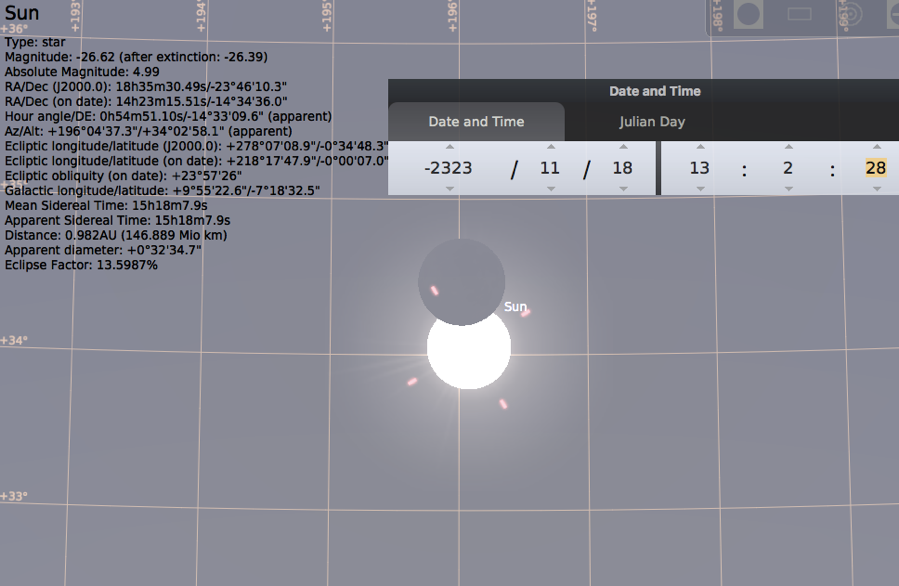
Figure 5: Predicted solar eclipse on 18 November 2324 BC, observed in Beijing, one of the important cities in 冀 州 (Ji-Zhou), the territory of Emperor Yao.
There are other astronomical records during the reign of Yao, which can further pin down the starting date of Yao. The Bamboo Annals recorded: "四十二年,景星见于翼; 帝在位七十年,景星出翼." Here is the English translation: "In his (Yao's) 42nd year, the brilliant star appeared in constellation Yi; when the emperor came to the throne 70 years, the brilliant star came out of constellation Yi."
"景星" literally means a brilliant star and Venus should be one of the candidates for the brilliant star. The Yi constellation contains Crater and Hydra with Crater being the center of the Yi constellation. The picture in the upper panel of Figure 6 shows that Venus rose from the east in the Yi constellation in the early morning of 18 August 2334 BC. If this happened in the 42nd year of Yao, the first year of Yao was after 18 August 2376 BC, in agreement with the conclusion drawn from the observed solar eclipse in the 53rd year of Yao.
The picture also shows that Venus came out of the Yi constellation in the evening from the west on 25 June 2306 BC (lower panel of Figure 6). If this took place in the 70th year of Yao, the first year of Yao should have been after 25 June 2376 BC.
These combined astronomical records consistently suggest that Yao should have started to reign between August 18 and November 18 of 2376 BC. The number of years that elapsed from the first year of Huang-Di (2716 BC) to the first year of Yao (2376 BC) was precisely 340, which was identical to that determined previously from Common Scheme.
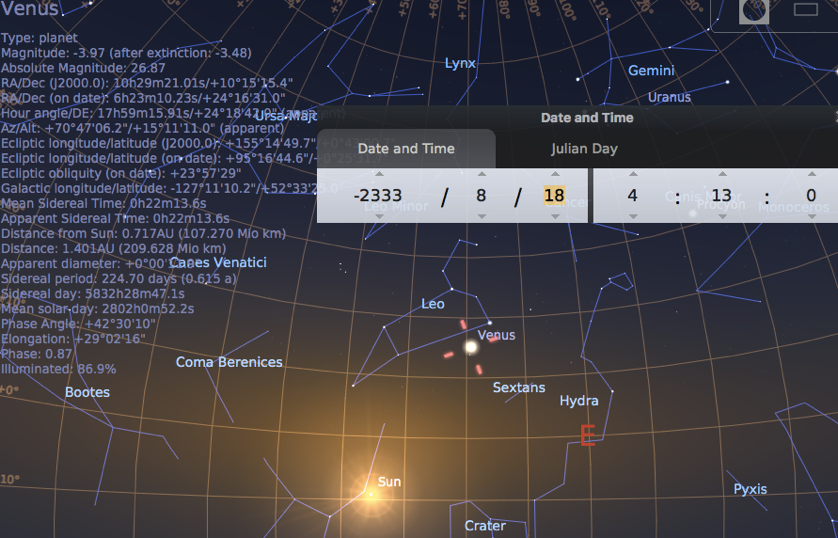
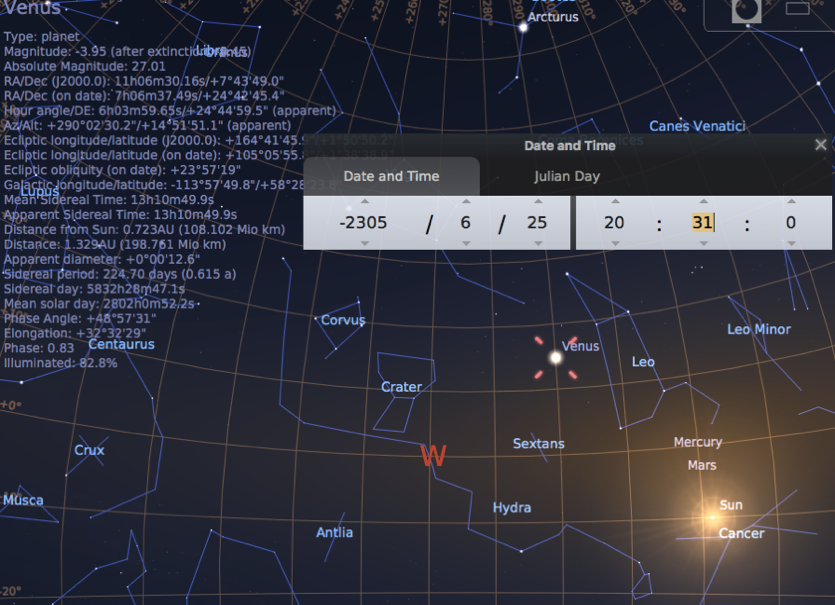
Figure 6: Venus rose in the east in the Yi constellation in the morning of 18 August 2334 BC (upper panel) and Venus came out of the Yi constellation from the west in the evening of 25 June 2306 BC (lower panel).
5. The first year of Emperor Shun
Now we determine the first year of Shun from an astronomical record in his first year. The Bamboo Annals recorded for Shun: "即帝位,蓂荚生于阶,凤凰巢于庭,击石拊石,以歌《九韶》,百兽率舞,景星出于房,地出乘黄之马." Our English translation reads: "Right upon his (Shun) ascension, the felicitous grew around the stars, the phoenixes nested in the courts. When they beat and tapped the musical stones to perform the Jiu-Shao music, all the beasts danced together, the brilliant star came out of the Fang constellation, and a Chen-Huang horse came out of the earth."
The picture in Figure 7 shows that Venus came out of Fang (Scorpius) on 14 September 2271 BC. It was still close to Fang until the evening of September 19. This suggests that Shun should have started his reign between 14 and 19 September 2271 BC, which was in the 7th month of 2271 BC.
Since Yao's regnal length was 100 years, there should have been 5 years between the death of Yao and the first year of Shun. The Bamboo Annals recorded: "一百年,帝陟于陶。帝子丹朱避舜于房陵,舜让,不克。朱遂封于房,为虞宾。三年,舜即天子之位." Here is the English translation: "Yao had reigned for 100 years and died. The emperor's son Dan-Zhu kept away from Shun in Fang-ling. Shun tried to yield his throne to Dan-Zhu but was unsuccessful. Dan-Zhu was bestowed as the prince of Fang and was the guest of Yu (Shun). After three years, Shun ascended to the throne of the son of Heaven."
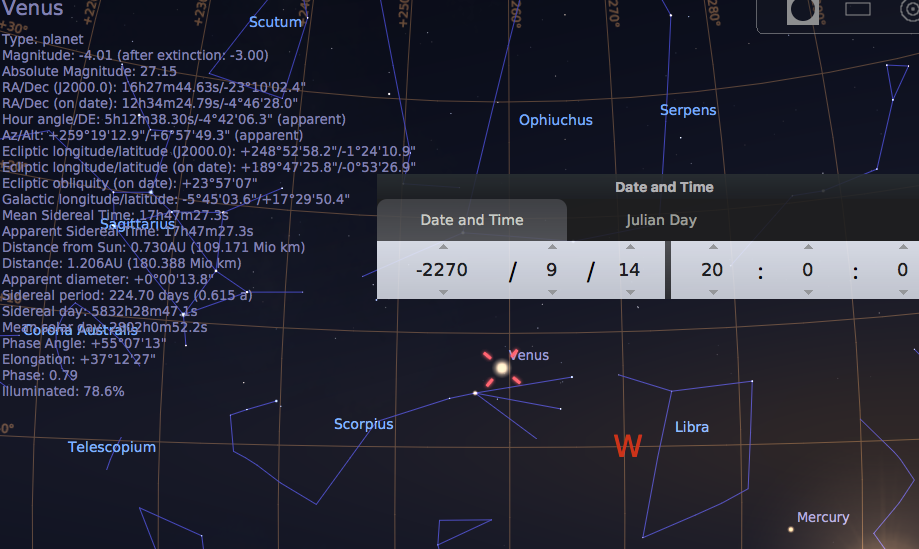
Figure 7: Venus came out of Fang (Scorpius) on 14 September 2271 BC.
A question arises as to whether "after three years" means three years after Yao's death or three years after Dan-Zhu was bestowed as the prince of Fang. Traditionally, the Chinese historians interpreted "after three years" as "three years after Yao's death." Since there is a gap of about five years between Yao's death and the ascension of Shun according to the astronomical records, "after three years" in the text should mean "three years after Dan-Zhu was bestowed as the prince of Fang." If this is the case, there should have been a gap of two years between Yao's death and Dan-Zhu being bestowed as the prince. Right after Yao's death, Dan-Zhu kept away from Shun possibly because he was afraid of being killed by Shun. But instead, Shun tried to yield his throne to Dan-Zhu although Yao had yielded his throne to Shun in Yao's 73rd year and Shun was the legal successor of the throne. After Shun found that his two-year effort to yield his throne to Dan-Zhu was not successful, he bestowed Dan-Zhu as the prince of Fang. Shun officially ascended to the throne of the son of Heaven three years after he received a sign from Heaven, that is, the brilliant star came out of the Fang constellation . This explains the five-year gap between the death of Yao and the ascension of Shun.
6. The first year of Emperor Zhong-Kang
The Bamboo Annals recorded: "帝仲康, 元年巳丑, 帝即位, 居斟鄩, 五年秋, 九月, 庚戍, 朔, 日有食之, 命胤侯帅师征羲和." Our English translation reads: "In the year of shi-chou (the 26th year of a sexagenary cycle), Emperor Zhong-Kang came to the throne and dwelt in Zhenxun. In his 5th year, in the autumn, in the 9th month, on day geng-shu (the 47th day of a sexagenary cycle), in the early morning, there was a solar eclipse. Then he ordered the prince of Yin to use military forces to take Xi and He (two drunken astronomers)."
The solar eclipse observed in the fifth year of Emperor Zhong-Kang has been considered to be the first human record of solar eclipses (this information can be found at the website: https://eclipse.gsfc.nasa.gov/SEhistory/SEhistory.html). Since the Bamboo Annals recorded two more solar eclipses before this one and the day of the solar eclipse was wrongly assigned (see below), the information in the NASA webpage needs to be updated.
The Chinese word "朔shuo" in the above text originally means "new moon" or "dark moon." To be more general, "朔" also means "beginning" and "early morning." Because a solar eclipse always occurs at a new moon, there is no point for the chronicler to say it again. Here, we interpret "朔" as "in the early morning," which describes the time of the solar eclipse.
In ancient China, the day started at sunset just like in the nation of Israel (see Chapter 5). The first day of a month starts in the evening if the conjunction of the Sun and the Moon (dark moon phase) falls before sunrise. On the other hand, the first day of a month starts in the following evening if the conjunction falls after sunrise. Since sunrise occurs at the mid-point of a day, a new month should start from an evening that is the closest to the time of the conjunction. Since a maximally visible solar eclipse is seen in the conjunction after sunrise, a solar eclipse should always occur in the last day of a lunar month. Indeed, only if the solar eclipses happened in the last day of a lunar month, all the solar eclipses recorded in the Bamboo Annals can be in perfect agreement with the regnal years of all the kings. Moreover, the Book of Later Han recorded every solar eclipse, which always occurred in the last day of a lunar month. This further confirms that the day in ancient China started from sunset.
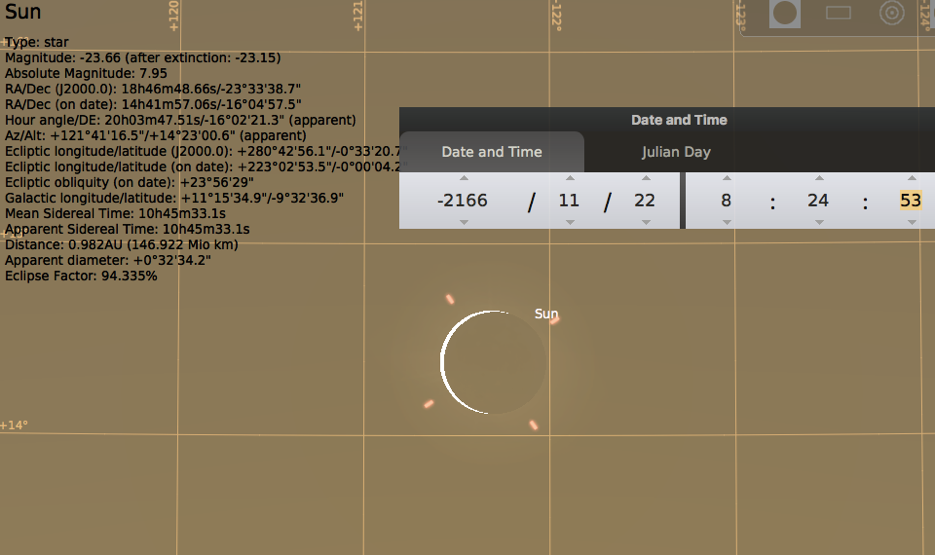
Figure 8: Predicted solar eclipse on 22 November 2167 BC, observed in Zhenxun.
On the other hand, if a day starts from midnight, then morning solar eclipses take place during the first day of a lunar month while afternoon solar eclipses occur during the last day of a lunar month. If a day starts from morning, then solar eclipses always take place in the first day of a month.
The same astronomical phenomenon was also recorded in the Shujing: "乃季秋月朔辰弗集于房." Our English translation is: "In the last month of autumn, in the early morning, the Sun and the Moon did not meet in the lunar mansion of Fang (Scorpio)."
Here, "季秋月" means the last month of autumn, the 9th lunar month. Both records in the Bamboo Annals and the Shujing consistently tell us that the solar eclipse occurred in the 9th month, in the early morning, and not in the lunar mansion of Scorpio.
The eclipse was observed in Zhenxun (Gongyi) (34o46'N112o58'E) on day yi-yu乙酉 (the 22nd day of a sexagenary cycle), according to the counting method of the Shang Dynasty.
With ΔT = –20 + 34.52t2, the maximum eclipse was at 8:24 with the eclipse factor of 94.36% (see Figure 8). The eclipse started at 7:20 right after sunrise (at 7:05) and ended at 9:37. The Sun and Moon did not meet in the constellation of Scorpio, but instead about 30 degrees from it. This is consistent with the description that the Sun and the Moon did not meet in the lunar mansion of Scorpio during the solar eclipse.
Since the new moon was at 21:52 on October 23, the first day of the 9th month started from the evening of October 23, and November 22 was in the 30th day of the 9th month, which also matched the historical record. The eclipse was seen between 7:20 and 9:37 in the morning, which was also consistent with the time "朔", "in the early morning." The day calculated from the counting method of the Shang Dynasty does not match the one that was recorded. This is understandable since the chroniclers in the Shang Dynasty may have reset the first day of a sexagenary cycle.
The number of years between the first year of Shun and the first year of Zhong-Kang also matches the number obtained from Common Scheme. According to the Bamboo Annals, Great Yu started to co-reign with Shun in the 14th year of Shun (from the autumn of 2258 BC to the autumn of 2257 BC). The Bamboo Annals also tells us that Heaven appointed Yu in replacement of Shun in the 14th year of Shun, which should have been around the fall of 2257 BC (near the end of the 14th year of Shun).
7. The first year of Zhou Wen-Wang
Superfluous Book of Zhou (逸周书·小开) recorded: "维三十有五祀,王念曰:"多□,正月丙子拜望,食无时。汝开后嗣谋,曰:呜呼!于来后之人。余闻在昔曰:明明非常,维德曰为明,食无时,汝日夜何脩非躬?何慎非言?何择非德?" Our English translation reads: "During the sacrifice ceremony in the 35th year of the king (Zhou Wen-Wang), the king said: 'the sacrifice ceremony is holding today in the day of bing-zi (the 13th day of a sexagenary cycle) in the first month because the previous lunar eclipse came untimely (and we missed the sacrifice). To inspire your descendants, you should say, 'Alas, your future generations, I learn that in the past the bright was not always bright except for virtue. Since lunar eclipses could come untimely, why don't you seek virtue by yourself day and night? Why don't you speak your words carefully? Why don't you choose virtue?'"
Several scholars proposed that there was a lunar eclipse on the 13th day of a sexagenary cycle, in the first month, in the 35th year of Zhou Wen-Wang. A lunar eclipse is predicted to occurr on 15 September 1112 BC, which matched the 13th day. But the day of September 15 can never be in the first month. Furthermore, this assignment would lead to the conclusion that the first year of Zhou Wen-Wang would have been in 1146 BC. This is in contradiction with the record of the Bamboo Annals, which shows that the first year of Zhou Wen-Wang was in 1178 BC, in the 12th year of Tai-Ding. He died in the spring of the 41st of Di-Xin according to the Bamboo Annals, which was in 1128 BC. From 1178 BC to 1128 BC, there were 50 years, which was in perfect agreement with the record in the Annals of Zhou: Wen-Wang reigned for 50 years.
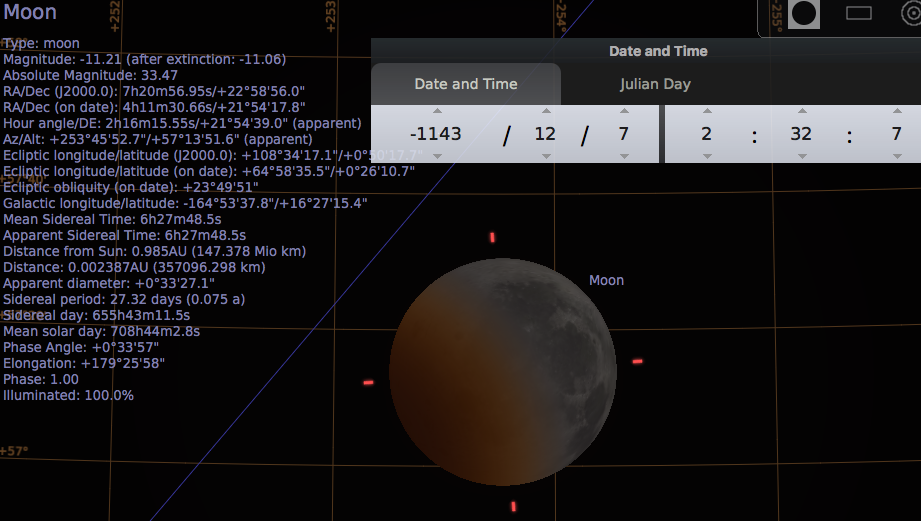
Figure 9: Predicted lunar eclipse on 7 December 1144 BC in Anyang.
If we carefully read the ancient text, we find the subtle meaning of the text. It does not actually say that the king made sacrifices in the first month and in the day of bing-zi because a lunar eclipse happened on that day. It is more logical to say that a lunar eclipse happened in the previous month, but the king missed the sacrificing ceremony because the eclipse took place in a day that was unexpected based on the common knowledge. If this is the correct understanding, there should have been a lunar eclipse in the 12th or 13th month of the previous year of 1144 BC. Indeed, a lunar eclipse was seen in China on 7 December 1144 BC (JD 1303917.27). It was on day xin-hai辛亥 (the 48th of a sexagenary cycle) rather than on the 13th day (bing-zi).
With ΔT = –20 + 28.2t2 and the observation point in Anyang (36o6'N114o20'), the maximum eclipse occurred at 2:32 with magnitude of 1.7 (see Figure 9). The new moon was at 17:29 of November 22, so the first day of the month started from the evening of November 22 and the lunar eclipse happened during the night of the 15th day of the month. It is known that a full moon and a lunar eclipse commonly takes place during the night of the 16th day at the end of a year. But this eclipse happened in the 15th day, which was not expected by the king. That is why he wanted to hold a special sacrificial ceremony in the beginning of the year to inspire people to seek virtue because everything, including the previous lunar eclipse, was uncertain except for virtue that is always bright.
We can easily show that the day bing-zi was on 1 January 1143 BC, the 10th day of the first lunar month in the time of Zhou Wen-Wang.