APPENDIX A The Delta-*T* Parameter for Eclipses
The orbital positions of the Sun and Moon required by eclipse predictions, are calculated using Terrestrial Dynamical Time (TD) because it is a uniform time scale. However, world time zones and daily life are based on Universal Time (UT). In order to convert eclipse predictions from TD to UT, the difference between these two time-scales must be known. The parameter delta-T (ΔT) is the arithmetic difference between the two as ΔT = TD – UT. Before 500 BC, the value of ΔT can be extrapolated from measured values using the long-term mean parabolic trend: ΔT = –20 + bt2 seconds, where t = (year–1820)/100 and b = 32.
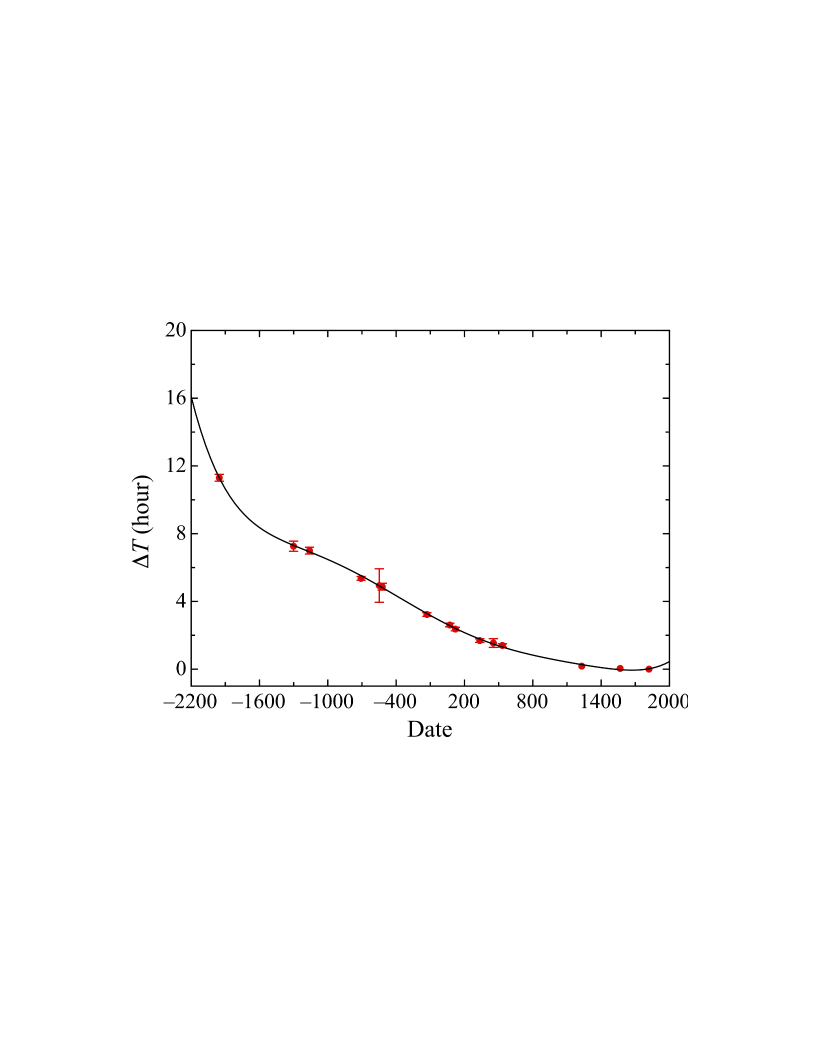
Figure A1: The ΔT parameter as a function of the Julian year
The ΔT parameters can be reliably obtained from the recorded total solar eclipses and from the recorded lunar eclipses with detailed beginning and ending times. The observed locations (coordinates) must also be given. The uncertainties of the ΔT parameters for total solar eclipses can be reliably determined. For lunar eclipses, the uncertainties of the ΔT parameters depend on how accurately the ancient astronomers recorded the beginning and ending times of the eclipses. Figure A1 shows the ΔT parameter as a function of the Julian year. The parameters are obtained from the total solar eclipses mostly observed in China and some in the Near East. The data are fitted with a sixth-order polynomial function (see the solid line in Figure A1):
ΔT = 2.8124 – 0.0035158j + 1.0979×10⁻⁶j^2^ + 6.827×10⁻¹⁰j^3^ -
5.1087×10⁻¹³j^4^ – 1.3103×10⁻¹⁶j5 + 1.1221×10⁻¹⁹j6
In the above equation, j is a Julian year. Positive j refers to a year after Messiah (AD) and negative j to a year before Messiah (BC). For example, j = 30 for 30 AD and j = –130 for 131 BC.
For any year before 2200 BC, we will use this fitted curve to calculate ΔT in hours. After we calculate ΔT value, we obtain b value by solving equation: ΔT = –20 + bt2, here t = (j–1820)/100 and ΔT is in seconds.